
Rail & Trackside
Safety-certified, deterministic communications for signalling and train-to-ground links, with zero tolerance for failure.
In critical infrastructure, network failure isn’t just downtime - it’s a public safety, environmental, or operational crisis. Throughput advises on secure, resilient OT network architectures that meet compliance, withstand threats, and keep the physical world running.
Operational Technology (OT) in rail, utilities, mining, and beyond operates under non-negotiable constraints: deterministic performance, safety integrity, harsh environments, and decades-long asset lifecycles. A generic network design fails them all.
Each vertical faces unique threats, standards, and operational rhythms - from SIL-rated rail interlocking to nuclear safety systems, from underground mine comms to city-wide ITS. Yet they share core principles: availability over confidentiality, resilience against physical and cyber disruption, and security that never compromises function. Throughput translates international standards (IEC 62443, EN 50159, NERC CIP) into deployable architectures that balance safety, compliance, and continuity - without hype or guesswork.
We educate integrators and end-users on how to build networks that survive lightning strikes, ransomware, supply chain tampering, and legacy protocol transitions - all while passing audit and keeping operations moving.
Rail networks demand safety-certified, deterministic communications aligned with IEC 62425 and EN 50159. From PRP/HSR-redundant signalling and GSM-R/LTE train-to-ground links to trackside fibre in lightning-prone corridors, every layer must ensure signal integrity, cybersecurity for SIL-rated systems, and remote monitoring of assets in extreme conditions - without single points of failure.
Power, water, gas, and nuclear OT requires absolute continuity under safety mandates like IEC 61508 and NERC CIP. Substation IEC 61850 networks, pipeline SCADA, and reactor protection systems rely on air-gap alternatives, deterministic timing, and ruggedized infrastructure - secured via OT/IT segmentation, zero-trust remote access, and supply chain controls that meet regulatory scrutiny.
Underground leaky feeder, surface plant Ethernet, and autonomous haul fleets operate in explosive, dusty, and remote environments. Networks must integrate legacy PLCs, support predictive maintenance data flows, and segment safety from production - all while surviving vibration, corrosion, and limited physical access, with cybersecurity embedded for mobile and remote-operated equipment.
Factory floors blend real-time protocols (PROFINET, EtherNet/IP, TSN) with machine safety (PROFIsafe) and IIoT data (OPC UA, MQTT). Resilient segmentation ensures 24/7 uptime, while OT-aware monitoring and patch management protect against disruption - enabling seamless integration with MES and cloud analytics without exposing control logic.
Urban infrastructure - from traffic signals and CCTV to air quality sensors and smart lighting - relies on integrated, city-wide networks that balance public access with life-safety resilience. Segmented zones, intrusion detection tuned to municipal data patterns, and secure remote access for maintenance ensure continuity during floods, outages, or cyberattacks.
Airports, ports, bridges, and energy microgrids form society’s backbone. Their networks combine geographically diverse redundancy, critical comms backhaul (P25/TETRA), and defence-in-depth aligned with national infrastructure standards - ensuring emergency operations continue even during partial physical or cyber compromise.
Life-safety systems - fire alarms, access control, and IP video - demand five-nines availability and fail-safe redundancy. Integration via PSIM platforms requires strict network segmentation, encrypted yet monitorable traffic, and physical-hardened infrastructure compliant with ISO 27001 and cybersecurity best practices for integrated physical security.
Highway VMS, tolling gantries, TMCs, and V2I networks operate in real-time with zero tolerance for downtime. Resilient architectures leverage diverse fibre paths, offline transaction caching, and OT-specific anomaly detection - ensuring traffic flows safely even during partial cyber or physical compromise, all while meeting transport-specific security standards.
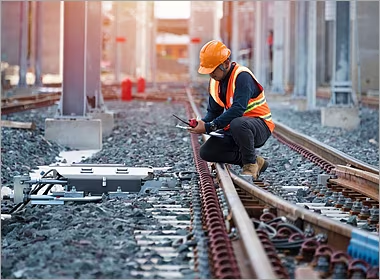
Safety-certified, deterministic communications for signalling and train-to-ground links, with zero tolerance for failure.
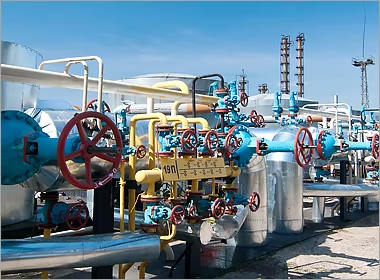
Absolute continuity for substation, pipeline, and nuclear OT under strict safety mandates.

Networks that survive explosive, dusty environments and integrate legacy systems.

Resilient segmentation blending real-time control with IIoT data for 24/7 uptime.

Integrated, segmented networks ensuring public service resilience during outages or attacks.
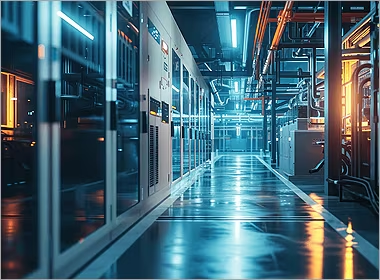
Geographically diverse redundancy and defence-in-depth for society's backbone.

Life-safety systems demanding five-nines availability, strict segmentation, and hardened infrastructure.
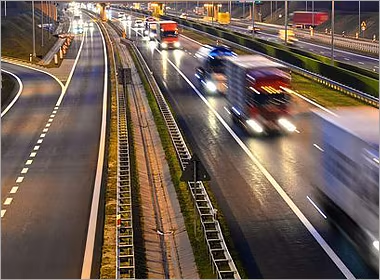
Resilient architectures with diverse paths ensuring zero-downtime for traffic management.
SIL-rated networks require deterministic protocols, certified hardware, and architectures like PRP/HSR for zero-recovery failover. Compliance with EN 50159 is non-negotiable, ensuring signalling data integrity, immunity to interference, and predictable behaviour under all fault conditions.
Defence-in-depth segmentation with unidirectional gateways and zero-trust remote access. Networks are partitioned into zones/conduits per IEC 62443, with rigorous access controls and monitoring. This creates logical "gaps" that allow necessary data flow while preventing attack propagation.
Yes. Protocol gateways translate legacy serial communications to secure Ethernet. These are deployed in segmented zones with strict firewall policies. The key is isolating legacy assets while enabling data extraction for monitoring, without exposing them to direct network access.
Security is implemented at the cell perimeter, not within the real-time domain. Segment each production cell, control engineer access, and use OT-aware monitors to detect anomalies in protocol traffic. This protects without adding latency to deterministic cycles.
Through strict physical or logical network segmentation. Critical traffic (traffic signals, CCTV) uses dedicated infrastructure or isolated VLANs with higher priority. Public access is routed through separate, firewalled networks with no pathway to control systems.
It means core network paths and control centres are physically separated—on different routes, in different buildings—so a single event (fire, flood, cut cable) cannot disable both. This is essential for airports, ports, and energy grids.
IT networks are designed for availability, not deterministic, fail-safe operation. Life-safety systems need guaranteed bandwidth, ultra-low latency, and isolated failure domains. Shared networks risk congestion or configuration errors disabling fire alarms or access controls during an incident.
Through offline transaction caching at the gantry. Transactions are stored locally and transmitted when connectivity is restored. The network design prioritises getting the "green light" signal to the vehicle over real-time billing data transfer.
Throughput Technologies brings sector-specific expertise to each industry we serve. We understand that railway signalling networks, utility SCADA systems, mining safety communications, and manufacturing automation each present unique challenges that demand specialised solutions. Our approach begins with your operational constraints and builds networks that respect them.
Contact us to discuss how industry-specific networking expertise can address your operational requirements while ensuring long-term reliability and compliance.