SECOMEA: Zero-Trust Secure Remote Access for Industrial Networks | Partner
When industrial systems must be accessed remotely without compromising safety, uptime, or compliance, Secomea delivers Zero-Trust secure access engineered specifically for the realities of operational technology.
Secomea
Secure Remote Access Built for OT, Not IT
Designing Access Control Around Operational Constraints, Not Generic Assumptions
Remote access in industrial environments demands security without disruption. Secomea solves this by designing access controlaround operational constraints, not generic IT assumptions.
Industrial operations increasingly depend on remote diagnostics, support, and optimisation. Yet traditional VPN approaches - borrowed from IT - introduce unacceptable risk into OT environments, expanding attack surfaces and violating segmentation principles. Secomea was built specifically to address this gap. Its platform enables precise, auditable, and role-based access to industrial assets such as PLCs, HMIs, and SCADA systems - without exposing entire networks or requiring permanent inbound connections.
This makes Secomea a foundational component in modern OT cybersecurity strategies, especially where uptime, safety, and regulatory compliance are inseparable. Unlike IT-centric solutions that force operational compromise, Secomea aligns security with how industrial systems are actually managed and maintained.
Zero-Trust Architecture by Design
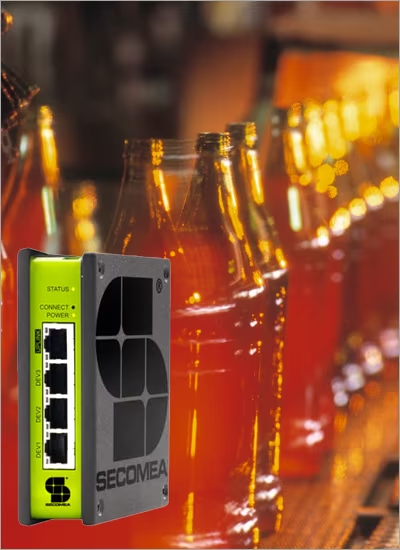
Replacing implicit trust with explicit verification for every industrial connection.
Secomea replaces implicit trust with explicit verification, ensuring every connection is authenticated, authorised, and logged - every time.
At the core of Secomea's platform is a Zero-Trust security model purpose-built for industrial environments. Access is granted only to explicitly authorised users, for explicitly authorised assets, for explicitly authorised purposes. The architecture eliminates the need for exposed ports, inbound firewall rules, or persistent VPN tunnels. Instead, outbound-initiated, encrypted connections ensure that industrial networks remain shielded from unsolicited access.
This model aligns naturally with defence-in-depth architectures delivered alongside resilient industrial networking from partners such as Westermo, where network integrity and access integrity reinforce each other rather than compete. When combined with protocol interoperability from ProSoft Technology, the result is a coherent security posture that spans network transport, protocol translation, and access control without gaps or contradictions.
A Unified Platform for Access, Control, and Audit
Secomea's platform separates access enforcement, user control, and session management into clear architectural layers for scalability and clarity.
The Secomea ecosystem is structured around three tightly integrated components: SiteManager deployed at industrial sites providing secure connectivity to PLCs and local networks; GateManager serving as the central policy engine where administrators define permissions and monitor activity; and LinkManager enabling technicians to connect securely through client software or browser-based access.
This separation of concerns ensures that access policies can evolve without touching production systems, audit trails remain comprehensive, and operational management maintains clarity even at scale. The architecture supports both cloud-hosted and on-premise deployments, providing flexibility for organisations with different security and compliance requirements while maintaining consistent security principles.
Security That Aligns with Compliance Reality
Regulatory compliance in OT is not theoretical. Secomea supports practical alignment with modern industrial cybersecurity frameworks.
Secomea is certified to IEC 62443 and supports organisations responding to regulatory obligations such as NIS2 and the Cyber Resilience Act. Importantly, these capabilities are delivered without forcing disruptive architectural changes. Multi-factor authentication, integration with enterprise identity providers (Azure AD, Okta, SSO), and detailed audit logging ensure that access governance meets both operational and regulatory expectations.
Secomea's recognition as a CVE Numbering Authority (CNA) further underscores its cybersecurity maturity - demonstrating not only compliance, but active participation in vulnerability disclosure and remediation processes. This proactive security stance provides assurance that the platform evolves in response to emerging threats rather than merely reacting to compliance checklists.
Ease of Deployment Without Compromise
Industrial security only works if it is adopted. Secomea prioritises rapid deployment without sacrificing architectural integrity.
Secomea's solutions are designed for record-speed deployment, often completed in hours rather than weeks. Crucially, this is achieved without requiring changes to existing firewall rules, IP schemas, or control logic. The platform is agentless, minimising operational disruption and reducing ongoing maintenance burden.
For machine builders and operators managing large installed bases, this simplicity is decisive - enabling secure access to scale without operational drag. When deployed alongside interoperability solutions from ProSoft Technology, Secomea enables secure access even in complex, multi-vendor control environments without exposing protocol boundaries or control planes.
Where Secomea Fits Across Throughput's Core Verticals
Secomea's relevance spans industries where remote access is essential but uncontrolled access is unacceptable.
| Vertical | Access Challenge | Secomea Role | Ecosystem Synergy |
|---|---|---|---|
| Manufacturing | OEM and vendor access to machines without exposing plant networks | Granular, time-bound access with session recording and audit trails | Complements ProSoft Technology interoperability for multi-vendor environments |
| Energy & Utilities | Remote substations and DER assets requiring secure maintenance access | Secure access without exposure of critical grid infrastructure | Aligns with Westermo resilient OT networks and Welotec cellular connectivity |
| Water & Wastewater | Unmanned pumping and treatment sites requiring auditable remote maintenance | Compliance-driven access control with detailed logging and reporting | Supports architectures meeting water sector cybersecurity regulations |
| Critical Infrastructure | Safety-critical remote operations requiring Zero-Trust principles | Enforcement of least-privilege access with multi-factor authentication | Integrates into defence-in-depth strategies alongside network segmentation |
IIoT Enablement with Security Intact
Secomea extends beyond access control, enabling secure data pathways between machines, operators, and higher-level systems.
Secomea's gateways support secure data collection and forwarding for IIoT and analytics use cases. Machine data can be accessed, contextualised, and transmitted without opening persistent network paths or bypassing segmentation controls. This capability allows organisations to extract operational insight while preserving the security posture of production networks.
This supports predictive maintenance, performance optimisation, and service innovation without increasing cyber exposure. The data pathways maintain the same Zero-Trust principles as remote access sessions, ensuring that IIoT initiatives don't inadvertently weaken security boundaries while pursuing operational improvements.
Designed for Operators, Trusted by Industry
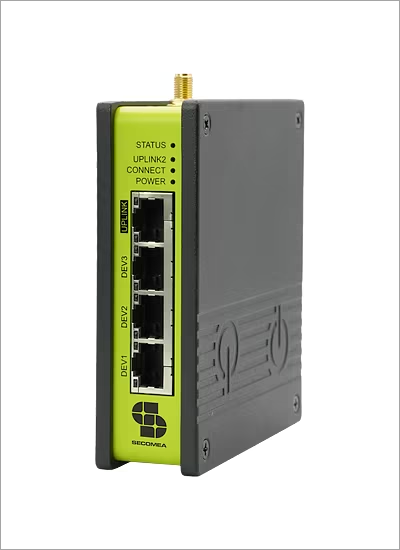
Certified security controls that meet industrial compliance requirements without disruption.
Adoption at scale reflects trust. Secomea is used globally by manufacturers, infrastructure operators, and OEMs who value both security and usability.
With over 8,000 customers worldwide, Secomea is deployed across food and beverage, pharmaceuticals, utilities, manufacturing, and infrastructure sectors. Its adoption reflects a balance rarely achieved in OT cybersecurity: strong security controls combined with operational usability. By respecting how industrial systems are actually built, operated, and supported, Secomea avoids the friction that causes many security initiatives to fail at the point of use.
This user-centric approach ensures that security enhances rather than hinders productivity - a critical consideration in environments where technical teams face competing operational priorities and time constraints.
The Throughput–Secomea Role: Integrating Access into Coherent Architectures
Throughput integrates Secomea into broader OT architectures to ensure remote access strengthens - not weakens - industrial resilience.
Secure remote access does not exist in isolation. Throughput positions Secomea within a complete architectural context - aligned with network segmentation, interoperability solutions from ProSoft Technology, resilient transport from Westermo, and lifecycle planning. The result is a remote access strategy that supports productivity, reduces downtime, and satisfies cybersecurity governance without undermining operational stability.
This architectural integration ensures that Secomea's Zero-Trust principles extend throughout the complete solution, creating coherent security rather than isolated point solutions that leave gaps between different technology layers.
In industrial networks, uncontrolled access is one of the greatest risks
- Secomea removes that risk by design.
Throughput Technologies partners with Secomea because remote access in OT environments must balance security with practicality. By replacing implicit trust with explicit authorisation, session logging, and granular control, Secomea transforms remote access from a vulnerability into a governed operational capability.
For organisations facing increasing cyber scrutiny and operational pressure, this clarity is essential - ensuring that remote connectivity supports efficiency and resilience without introducing hidden risk.
Talk with a Solutions Specialist
Where is remote access exposing your systems - without full control?
Answered – Some Frequently Asked Questions
Traditional VPNs create network-to-network tunnels that expose entire segments, violate segmentation principles, and rely on implicit trust. Secomea implements Zero-Trust principles with user-to-application access, granting permission only to specific resources rather than network segments. Connections are outbound-initiated (no open firewall ports), sessions are time-limited and recorded, and access is continuously verified. This approach dramatically reduces attack surface while providing granular control and comprehensive audit trails - addressing the fundamental security weaknesses of VPN architectures in OT environments.
Yes. Secomea is designed to integrate with existing infrastructure without requiring firewall rule changes or network reconfiguration. The SiteManager gateway establishes outbound connections to the GateManager, meaning no inbound ports need to be opened on perimeter firewalls. This makes deployment straightforward and maintains existing security boundaries. When combined with segmented network architectures delivered by partners like Westermo, Secomea enhances rather than conflicts with established security postures.
Every Secomea connection generates a comprehensive audit trail including: who connected, when, from where, to what resource, for how long, and what actions were performed. Session recording captures the complete interaction, providing an immutable record for compliance, troubleshooting, and security investigations. These logs are centrally stored and protected against tampering, supporting regulatory requirements like NIS2 and IEC 62443. For organisations with complex compliance obligations, this detailed audit capability provides essential evidence of controlled access practices.
Yes. Secomea supports integration with enterprise identity providers including Azure Active Directory, Okta, and other SAML/SSO solutions. This enables consistent identity management across IT and OT environments, eliminates separate credential stores, and supports multi-factor authentication using existing enterprise infrastructure. The integration maintains the Zero-Trust principle while simplifying administration and ensuring that access policies align with organisational security standards rather than creating isolated OT-specific exceptions.
Throughput positions Secomea as the access control specialist within comprehensive security architectures: working alongside Westermo for network segmentation and transport security, ProSoft Technology for protocol-level interoperability, and Welotec for secure cellular connectivity. This integrated approach ensures that security principles extend consistently from network perimeter to individual device access, creating defence-in-depth rather than isolated point solutions. Throughput's architectural oversight coordinates these capabilities into coherent solutions where each layer reinforces rather than conflicts with the others.