
Field & Edge Connectivity for Fire & Security
Designing robust connectivity between panels, sensors, cameras, and controllers that remains stable across distance, power variation, and environmental stress.
Modern fire and security systems depend on robust networks that deliver real‑time detection, coordinated response, and continuous protection. From fire alarms to video surveillance, access control to integrated platforms – each system demands specific network design considerations for reliability, security, and performance.
Physical protection systems have evolved from isolated components to integrated ecosystems. Fire detection networks alert occupants and emergency services. CCTV systems provide visual monitoring and evidence. Access control manages entry points and movement. Integrated platforms coordinate these systems for intelligent response. Each requires network infrastructure designed for its specific demands – from the deterministic timing of fire alarm panels to the high bandwidth of video surveillance.
Fire and security networks operate in diverse environments: corporate campuses, industrial facilities, public spaces, and critical infrastructure. They must maintain operation during power outages, network failures, and emergency situations. Cybersecurity is equally critical as these systems become more connected – protecting against unauthorized access, data tampering, and service disruption while maintaining availability for life‑safety functions.
Fire and security networks balance conflicting requirements. Fire alarm systems demand absolute reliability with fail‑safe operation. CCTV requires high bandwidth and storage capacity. Access control needs low‑latency authentication. Integrated platforms require cross‑system communication without introducing vulnerabilities. Network architecture must address these diverse needs through segmentation, quality‑of‑service policies, redundant design, and security controls that protect without impeding emergency response.
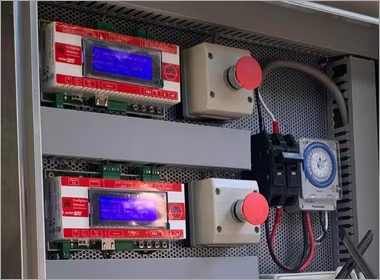
Designing robust connectivity between panels, sensors, cameras, and controllers that remains stable across distance, power variation, and environmental stress.

Structuring monitoring environments that support clear alarm handling, operator confidence, and coordinated response during critical incidents.

Containing cyber risk and access exposure without undermining alarm integrity, availability, or life safety performance.
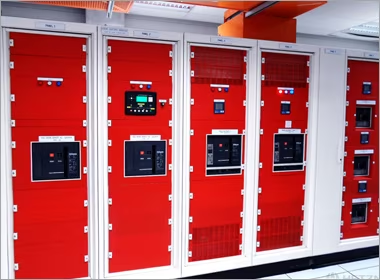
Discover how a segmented and deterministic network foundation prevents alarm delays and maintains system integrity under all conditions.
Throughput Technologies partners with manufacturers specialising in fire and security networking solutions. Westermo industrial switches provide reliable connectivity for fire alarm and security systems with wide temperature tolerance and vibration resistance. Secomea secure remote access enables monitoring and maintenance of security systems without compromising network security. ATOP Technologies switches with cybersecurity features protect fire and security networks from unauthorized access while maintaining performance. ProSoft Technology solutions facilitate integration between different security subsystems and protocols. FlexDSL connectivity extends network reach for distributed fire and security deployments, while Welotec edge computing devices process security analytics and fire detection data locally.
Fire and security systems evolve toward predictive protection and intelligent response. Future networks must support AI‑driven analytics detecting anomalies before incidents occur, automated response coordination between multiple systems, cloud‑edge hybrid architectures balancing local processing with central intelligence, and IoT sensor integration expanding detection capabilities. Emerging technologies include wireless fire detection reducing installation complexity, video analytics identifying security threats automatically, and blockchain‑verified audit trails for compliance reporting. Networks must maintain the reliability required for life‑safety functions while accommodating these advances and protecting against increasingly sophisticated cyber threats targeting physical security infrastructure.
Each topic above addresses a critical component of fire and security network design, providing guidance for security system designers, network engineers, and facility managers implementing comprehensive protection systems.