
Network Architecture for Fire & Security
Discover how a segmented and deterministic network foundation prevents alarm delays and maintains system integrity under all conditions.
Monitoring platforms determine operator response. Under incident stress, unclear interfaces and ambiguous data lead to delayed decisions, not faster action.
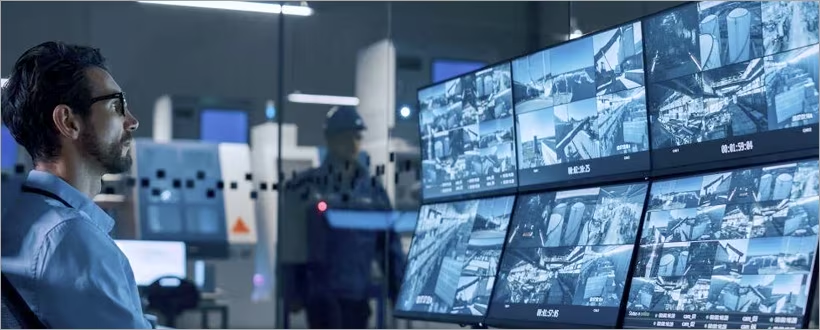
Interface complexity obscures critical signals when seconds matter most.
Modern fire and security monitoring platforms aggregate vast amounts of data: alarms, video feeds, access logs, HVAC status, and device diagnostics. During normal operations, this richness is a benefit. During an incident, it becomes noise. Operators are forced to filter, correlate, and interpret signals under high stress, increasing the risk of error or delay.
The failure mode is not a system crash, but cognitive overload. Platforms that work perfectly in testing can become unusable when multiple alarms fire, video streams buffer, and non-critical alerts compete for attention. The architecture must prioritize clarity over comprehensiveness during emergencies.
Presenting an alarm is not the same as supporting its resolution.
Many platforms excel at logging and displaying alarms but provide little contextual support for handling them. An alarm from Zone 5, Level 2 is just a point on a map without immediate access to relevant camera feeds, access control status for that zone, ventilation system override controls, and pre-defined response protocols.
Effective platforms are designed around alarm handling workflows. They surface the tools and information needed for the next decision, reducing the number of screens, clicks, and cross-references an operator must manage under pressure.

Platforms should integrate systems for the operator, not force the operator to integrate information mentally.
Operators should not be the integration layer between disparate systems.
It is common for fire, security, BMS, and communications systems to remain in separate software silos, even if they share a network. During an incident, the operator must mentally correlate events across these interfaces - a fire alarm on one screen, a video feed on another, and door controls on a third. This mental load is unsustainable and error-prone.
A well-structured platform performs this correlation automatically, presenting a unified situational view. The technical integration work is done in the background so the operator can focus on response, not data synthesis.
Platform responsiveness must be guaranteed, not just average.
Under test conditions with a handful of alarms, platform response is often snappy. Under real incident load - with dozens of alarms, multiple live video streams, and control commands being issued - databases queue, interfaces lag, and video buffers. This latency directly translates to delayed response.
Architecting for deterministic performance means prioritizing critical processes, provisioning sufficient backend resources, and validating performance under simulated peak loads that reflect worst-case incident scenarios, not typical daily operation.
The user interface must adapt to context, remaining static layouts hinder response.
A monitoring screen configured for daily oversight is poorly suited for incident management. During an emergency, the interface should transform: suppressing routine status information, enlarging critical alarms and relevant controls, and providing a clear, step-by-step workflow for acknowledged procedures.
This requires an interface designed with distinct operational modes - normal, alert, and incident - each with its own visual hierarchy and data presentation rules. The transition between these modes should be automatic, triggered by system state, not manual operator configuration.
Failover must be seamless for the operator, not just the server.
High-availability server clusters are standard, but if a failover event requires operators to reconnect clients, re-authenticate, or lose their active incident context, the technical redundancy fails its operational purpose. Session state and incident workflow must be preserved across hardware failures.
True operational continuity means the operator may see a brief pause or notification, but their screen, active alarms, pulled video feeds, and command context remain intact. The platform’s resilience is measured in uninterrupted operator effectiveness, not just server uptime.
Correlating signals from multiple systems increases alarm confidence and reduces nuisance responses.
Not all alarms are created equal; platforms should help distinguish them.
A single smoke detector alarm has a different probability of being a true fire than a combined signal from a smoke detector, heat sensor, and flame detector in the same zone. Similarly, a door-forced-open alarm paired with verified video motion has higher security confidence.
Advanced platforms perform basic correlation and confidence scoring, presenting operators with a prioritized assessment. This reduces reaction to nuisance alarms while heightening attention to high-probability, high-risk events. It turns raw data into actionable intelligence.
Reliable integration depends on structured data exchange, not custom code.
Proprietary integration between fire panels, VMS, and access control is brittle and costly to maintain. Monitoring platforms should act as integration hubs using open, standards-based protocols (e.g., BACnet, OPC UA, ONVIF for video) where possible. This reduces dependency on any single vendor and allows subsystems to be upgraded or replaced without rebuilding the entire monitoring interface.
The platform’s architecture should enforce data normalization, translating vendor-specific signals into a common operational model for consistent presentation and control.
Every action must be logged with unambiguous context for post-incident review.
After an incident, understanding the timeline of operator actions, system responses, and automated procedures is critical. Audit logs must capture not just the “what” (e.g., “door unlocked”), but the “why” (e.g., “by operator John Doe in response to alarm ID 4572”).
This requires tight coupling between the alarm database, control actions, and user session management. Immutable, timestamped logs are a non-negotiable requirement for liability management, regulatory compliance, and continuous improvement of response procedures.
The platform must accommodate new sensors and intelligence without redesign.
The definition of a “threat” evolves. Today’s platform might integrate fire, intrusion, and video. Tomorrow, it may need to incorporate gunshot detection, air quality sensors, or social media monitoring. A monolithic, hard-coded architecture cannot adapt.
A modular platform, built on a service-oriented or microservices architecture, allows new data sources and analytics engines to be plugged in as services. This ensures the monitoring environment can evolve with technology and threat profiles, protecting the long-term investment in the control infrastructure.
Throughput Technologies advises on monitoring and control platform architectures that reduce cognitive load and support decisive action.
Talk with a Solutions Specialist to assess your monitoring environment's incident readiness.
Designing for data presentation instead of decision support. Platforms that show every possible data point force the operator to search for relevance during a crisis. The focus should be on filtering, correlating, and presenting only the information necessary for the next immediate action, with deeper data available on demand, not by default.
Yes, but integration must be deep, not superficial. A unified platform must understand the distinct protocols, response timelines, and regulatory requirements of each domain. Simply displaying fire and security alarms on the same screen is not enough. The platform must manage the different priorities (life safety vs. asset protection) and provide domain-specific handling workflows without forcing operators to switch between separate "modes" mentally.
It is critical. Sub-second latency is expected for control commands and alarm acknowledgement. Delays of even a few seconds in video streaming or screen refresh during a high-stress event destroy operator confidence and can lead to missed cues or repeated commands. Performance must be tested under simulated peak load, not just average conditions, with guaranteed resources for critical functions.
The decision is based on connectivity resilience, data sensitivity, and regulatory compliance. For life safety, the primary concern is uninterrupted operation. If wide-area network connectivity is not utterly dependable, critical control functions must remain on-premise. Hybrid models, where cloud services provide analytics, reporting, and remote oversight while on-premise systems handle real-time control and alarming, are often the most resilient architecture.
By insisting on open, standards-based interfaces for integration and a modular software architecture. Avoid platforms that rely on proprietary protocols for all integrations, as they create vendor lock-in. Choose systems with a published API and support for industry standards (e.g., OPC UA, ONVIF, BACnet). This ensures you can incorporate new technologies, sensors, or subsystems over the platform's lifespan without a complete and costly replacement.
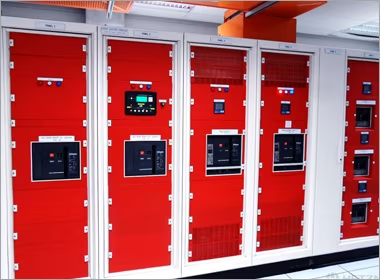
Discover how a segmented and deterministic network foundation prevents alarm delays and maintains system integrity under all conditions.
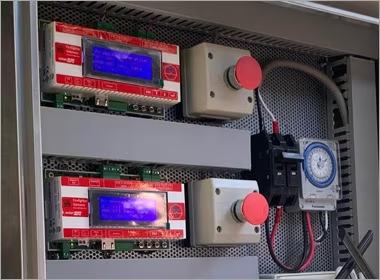
Understand why most system failures originate at the edge and how to design field-level connectivity that is as reliable as your core.

Learn how to implement robust cybersecurity controls that protect life safety systems without introducing new points of failure or complexity.