
Industrial Ethernet Networks
Industrial Ethernet is not just IT networking in a hard hat. It is a foundational engineering discipline where network predictability directly determines control system safety, process uptime, and operational confidence.
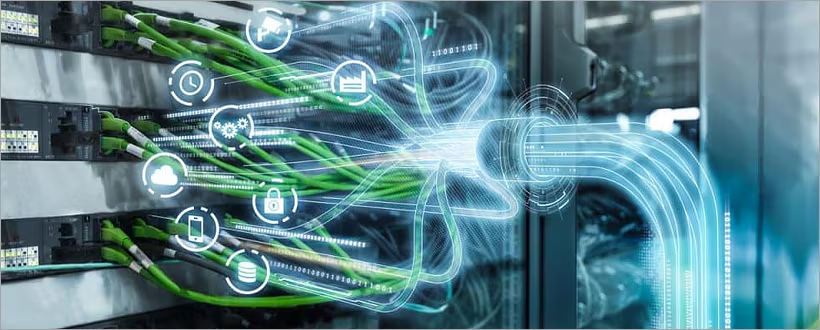
Engineering Predictable Behaviour in Operational Environments
The Critical Gap Between IT Ethernet and Industrial Reality
Standard Ethernet, designed for flexible office networks, introduces unacceptable uncertainty into environments where millisecond delays can trigger safety systems or halt production.
The assumption that Industrial Ethernet is merely a faster, IP-based replacement for legacy fieldbus systems is where many operational failures begin. In control environments, the network ceases to be just a data pipe; it becomes an integral, active component of the control loop itself. Its performance characteristics - latency, jitter, recovery time - are directly factored into the logic of safety interlocks, motor drives, and protection relays.
When commercial-grade Ethernet is deployed without architectural discipline, it inherits the statistical, best-effort nature of IT networking while being burdened with the zero-tolerance consequences of industrial failure. The result is not always a dramatic collapse, but a creeping erosion of predictability that manifests as unexplained trips, production slowdowns, and a loss of engineering confidence.
Why Standard Ethernet Fails in Industrial Contexts
The failure modes in OT environments are subtle, cumulative, and rooted in the fundamental design goals of standard Ethernet: shared medium access and statistical multiplexing.
Industrial systems demand deterministic performance, but standard Ethernet provides probabilistic performance. This mismatch creates specific, chronic failure points:
These issues are not solved by buying "industrial-rated" switches. They are solved by architectural decisions made before any hardware is specified.
The Architectural Imperative: Determinism Over Speed
The defining characteristic of Industrial Ethernet is not bandwidth, but bounded and predictable behaviour under all conditions, including during failures.
A network that delivers 99.9% of packets with microsecond latency but occasionally delays a critical command by 100 milliseconds is unsafe. Deterministic architecture enforces known boundaries on performance. This is achieved through controlled design, not hope.
A deterministic Industrial Ethernet architecture is built on four pillars:
- Controlled Topology: Using ring or star topologies with sub-50ms recovery protocols (like PRP, HSR, or MRP) instead of relying on reconverging trees.
- Strict Traffic Engineering: Implementing Quality of Service (QoS) with guaranteed bandwidth allocation and priority queuing for control traffic.
- Behavioural Segmentation: Isolating traffic types (control, safety, video, IT) into separate domains to prevent interference.
- Comprehensive Visibility: Deploying monitoring that measures latency, jitter, and packet loss trends to detect degradation before failure.
Segmentation: The Foundation of Contained Behaviour
In industrial networks, segmentation serves a dual purpose: security and performance isolation. It ensures a disturbance in one area does not propagate unpredictably.
Effective segmentation creates logical behavioural zones, typically implemented with VLANs and firewalls at aggregation points. A robust zoning strategy might include:
| Zone | Typical Traffic | Isolation Rationale |
|---|---|---|
| Safety & Critical Control | Safety PLC comms, emergency stops, protection trips | Absolute priority; zero tolerance for delay or interference from any other system. |
| Basic Process Control | PID loops, drive control, SCADA polling | Requires bounded latency; must be isolated from best-effort IT traffic. |
| Supervisory & HMI | Operator workstation traffic, alarm servers, historians | Higher bandwidth needs; can tolerate brief delays but must not impact control zones. |
| IT & Enterprise | File transfers, backups, email, ERP access | Classic best-effort traffic; must be contained to prevent affecting OT performance. |
Integrating Legacy Systems and Diverse Protocols
Industrial networks are rarely greenfield. True architecture accommodates serial devices, proprietary protocols, and multi-vendor equipment without sacrificing determinism.
The goal is controlled integration, not forced obsolescence. This involves strategic placement of protocol gateways and media converters that translate legacy traffic (like Modbus RTU or PROFIBUS) onto the IP network within defined, manageable segments. These gateways must themselves be deterministic - adding minimal and consistent latency - and their failure must not create a single point of failure for the legacy systems they support.
A successful integration strategy respects asset lifecycles, allowing for phased modernisation while maintaining overall network predictability.
Security and Resilience: Two Sides of the Same Coin
In industrial settings, security measures that disrupt deterministic behaviour are themselves a safety risk. Resilience ensures operations continue during an attack or failure.
Security must be applied at architectural boundaries (between zones) rather than inline within deterministic paths. Techniques include:
True resilience means the network can suffer a component failure or a security incident and maintain a known, acceptable level of operational performance.
The Lifecycle Perspective: Designing for Decades of Change
Industrial networks operate for 15-20 years or more. The architecture must be inherently adaptable to survive technological and operational evolution.
This means designing with clear expansion points, using standardised and well-documented interfaces, and implementing change management processes that validate network performance before any modification goes live. The architecture should make it easy to do the right thing (add a device to the correct zone) and difficult to do the wrong thing (connect a camera directly to the control network).
Industrial Ethernet succeeds when it is treated as an engineered control system, not a commoditised IT utility.
Throughput Technologies provides the architectural clarity and engineering discipline required to transform Ethernet from a source of operational uncertainty into a foundation of predictable performance. We help you move from reactive troubleshooting to proactive, confidence-based operation.
Talk with an Industrial Networking Specialist to conduct an architectural review of your current environment and define a path to deterministic resilience.