Industrial Ethernet Networks
Engineering deterministic behaviour and predictable performance for control and safety systems in operational environments.
Industrial networks communicate their health long before they fail - through subtle shifts in timing, intermittent errors, and changing traffic patterns. Diagnostics translate these signals into operational awareness, turning silent risk into visible, actionable intelligence.
Unlike IT networks where failure is loud and immediate, operational networks degrade quietly - control loops keep running while latency drifts, packet loss appears intermittently, and margins erode unseen until a critical threshold is crossed.
This silent degradation makes industrial network issues notoriously difficult to diagnose. By the time operations feel the impact - a stalled production line, a missed safety signal - the root cause is often buried under layers of secondary effects. Troubleshooting becomes guesswork, time is lost, and confidence erodes as temporary fixes replace proper resolution.
The core problem is not a lack of data, but a lack of the right data presented in operational context. Network diagnostics and monitoring exist to close this gap between cause and consequence, providing the evidence needed to move from reactive firefighting to proactive management.
Many industrial environments monitor device presence - whether a switch is “up” - but lack insight into actual network behaviour, which is where real operational risk manifests.
Knowing a device is powered tells you nothing about whether it is forwarding traffic correctly, whether links are retransmitting excessively, or whether timing assumptions remain valid. True diagnostics focus on behaviour, not presence. They answer operational questions: Is traffic flowing as the design intended? Has anything changed - intentionally or otherwise? Are performance margins shrinking over time?
This requires monitoring that understands industrial protocols, respects deterministic timing, and can distinguish between normal process variation and meaningful deviation. Generic IT tools that focus on utilisation and uptime miss the subtle indicators that matter most in control environments.
Active probing and scanning - common in IT diagnostics - can disrupt sensitive industrial protocols. Effective OT monitoring must be passive, building an accurate baseline of normal operation without introducing risk.
Many industrial devices and protocols are sensitive to unexpected packet types, timing disruption, or increased broadcast traffic. Passive monitoring using network taps or switch SPAN ports observes traffic without injecting any packets. This allows engineers to build a precise picture of normal communication paths, typical traffic volumes and timing, and expected device interactions.
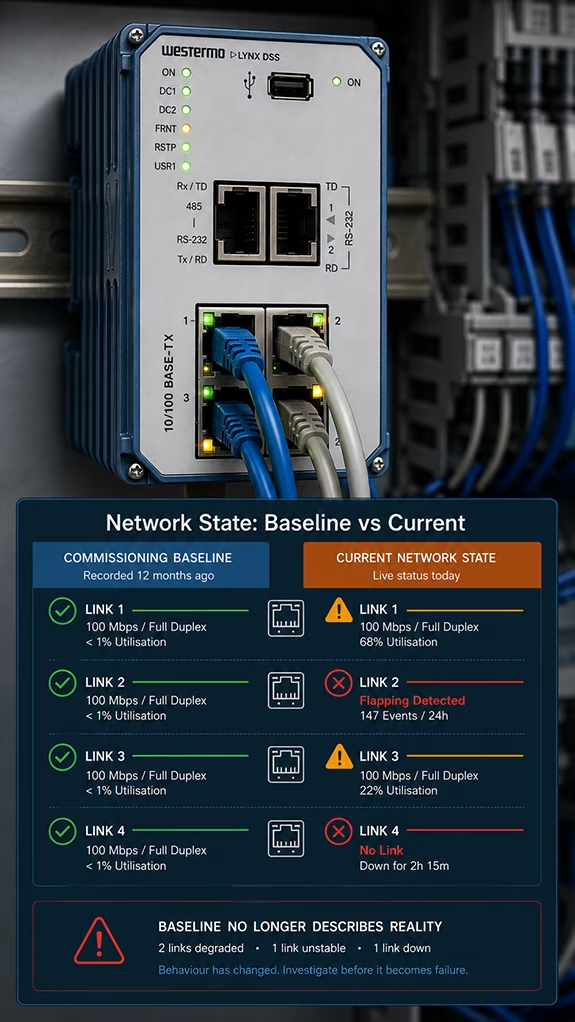
Once this empirical baseline exists, deviations become visible and meaningful. A controller initiating an outbound connection when it should only respond, a sudden change in message frequency, or traffic appearing on an unused VLAN - these anomalies signal potential issues long before they cause operational impact.
Traditional diagnostics are reactive - something breaks, and tools help find out why. Modern industrial networks demand a preventive approach that identifies degradation before it becomes failure.
As networks converge - carrying control, safety, video, and enterprise traffic - the margin for error narrows. A single misconfiguration or degraded link can affect multiple systems simultaneously. Effective monitoring shifts focus upstream, identifying trends rather than isolated events.
| Monitoring Approach | Typical Outcome | Operational Impact |
|---|---|---|
| Reactive (Threshold Alarms) | Alerts when a link error rate exceeds 5%. The link may already be unstable, causing intermittent control issues. | Emergency troubleshooting during production. Downtime or quality issues likely. |
| Preventive (Trend Analysis) | Identifies that link errors have increased from 0.01% to 0.5% over three months, indicating a degrading transceiver. | Schedule replacement during next planned maintenance. No operational disruption. |
Prevention is not about perfect prediction; it is about reducing surprise and enabling evidence-based maintenance decisions.
In industrial environments, “normal” is not a single static state - it varies by production phase, time of day, and process conditions. Effective diagnostics must be context-aware.
A traffic pattern acceptable during commissioning may indicate a problem during peak production. A network burst harmless in one process could destabilise another. Short monitoring snapshots reveal little; trends across operational states reveal the truth. By observing networks over time - through maintenance windows, shift changes, and seasonal variations - engineers can distinguish meaningful change from normal variation.
This long-term perspective transforms troubleshooting from speculation into analysis. It reveals gradual increases in latency, growing error rates on physical links, and the subtle impact of new devices or configuration changes.
Network problems often create organisational friction as teams debate whether the issue lies with the network, the application, device firmware, or the process itself.
Without clear diagnostics, each team defends its domain while the problem persists. Comprehensive network visibility changes this dynamic. When traffic flows, timing, and error conditions are objectively visible, discussions become factual. Engineers can demonstrate conclusively whether the network is behaving as designed - or not.
This clarity is particularly valuable in environments with multiple vendors, external integrators, or remote support teams. It reduces time wasted on blame assignment and focuses effort on collaborative problem-solving. In safety-critical or regulated environments, this objective evidence also supports compliance and audit requirements.
Network diagnostics and monitoring are not isolated disciplines - they provide the essential feedback loop that validates architecture and enables security and resilience.
Without visibility, segmentation cannot be validated, security incidents are harder to detect, redundancy mechanisms cannot be trusted, and performance guarantees remain assumptions. Monitoring provides the empirical evidence that turns design intent into operational reality.
In cybersecurity, it establishes the behavioural baseline needed for anomaly detection. In resilience planning, it provides the data to validate failover performance and recovery times. During incidents, historical network data allows teams to reconstruct events, identify root causes, and provide definitive accounts of what did - and did not - occur.
Industrial networks operate for decades; diagnostics systems must be designed with similar longevity, not as temporary tools that require constant tuning.
Solutions that demand frequent updates, specialist oversight, or complex interpretation quickly become unused - visibility fades and blind spots return. Effective monitoring architectures are stable over long periods, simple for operations to interpret, designed to coexist with legacy equipment, and resilient to partial failure. They become an integral, trusted part of the operational infrastructure, not an accessory.
Throughput Technologies approaches network diagnostics and monitoring as a decision-support discipline. We focus on helping teams understand what matters in their specific environment, choosing visibility methods that align with operational risk, and designing monitoring architectures that provide continuous, trustworthy insight without disruption.
Talk with a Diagnostics & Visibility Specialist to explore how structured monitoring can transform your network from a source of uncertainty into a foundation of operational confidence.
Begin with passive network taps or SPAN ports on core switches. This provides complete visibility without any risk to production traffic. Start by collecting data for 2–4 weeks to establish a baseline of "normal" behaviour - understanding typical traffic patterns, device conversations, and protocol usage. This evidence-based approach reveals the actual network architecture (which often differs from documentation) and identifies the most critical flows to monitor long-term.
For deterministic performance, focus on consistency rather than averages. Measure maximum latency (worst-case), jitter (variation in latency), and packet loss - especially consecutive packet loss. Monitor these metrics for specific control traffic flows, not just overall link performance. Also track switch buffer utilisation and queue depths, as congestion here directly impacts timing. The goal is to verify that latency stays within the bounded limits required by your control systems.
Yes, through intelligent data reduction at the edge. Deploy local collectors at remote sites that analyse traffic and send only metadata, summaries, and alerts - not raw packet data - over the constrained link. Use compression and send detailed forensic data only on demand or during scheduled off-peak windows. The key is prioritising what needs real-time visibility (alerts, performance counters) versus what can be analysed locally or transferred later.
Correlate data across layers. If a device appears unresponsive, check whether the network shows successful TCP handshakes (proving connectivity) and whether the device is sending any traffic at all (proving it's powered and functional). If an application is slow, measure network latency between its components and compare to baseline. The network can only be blamed if it is demonstrably not delivering packets as designed - excessive latency, loss, or errors on the path. This layered evidence ends speculation.
Retain detailed packet data for 7–30 days for troubleshooting recent incidents. Keep performance metrics (latency, loss, utilisation) for at least 13 months to observe seasonal patterns and year-on-year trends. Maintain high-level summaries and alert logs indefinitely for compliance and historical analysis. Storage strategy should be tiered - fast access for recent data, cheaper archival for historical trends. The value of long-term data is in understanding gradual degradation and providing evidence during post-incident reviews.
Engineering deterministic behaviour and predictable performance for control and safety systems in operational environments.
Implementing security controls that protect operational continuity and safety without disrupting deterministic network behaviour.
Designing networks that continue to operate predictably during component or path failures through deterministic recovery.