
Protocols & Industrial Communications
Foundational language - everything builds on this. How industrial protocols behave: timing, determinism, addressing, resilience, and longevity. Not trends - what lasts.
Industrial communication happens through physical media in real environments. Connectivity choices either support long-term operational stability or quietly undermine it - because in the battle between design and environment, the environment always wins.
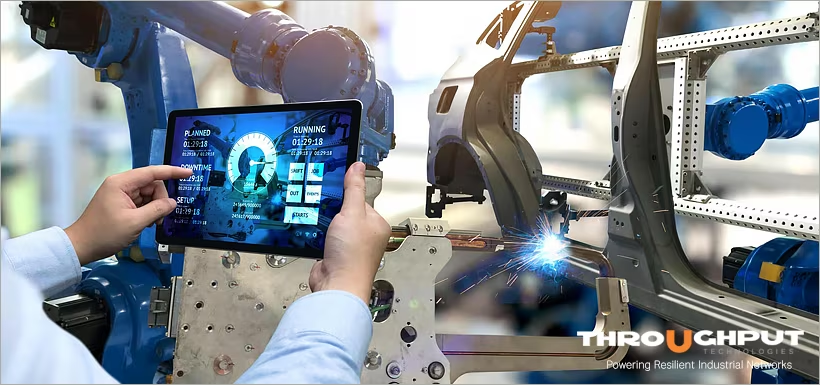
Media decisions are often treated as secondary concerns after protocols and devices are chosen, leading to systemic risk when the physical layer fails to match operational reality.
In industrial systems, connectivity determines signal integrity over distance, immunity to electrical noise, failure behaviour under stress, and the longevity of the entire installation. When media choices are wrong, problems rarely appear immediately. They emerge as intermittent faults, unexplained dropouts, and degraded performance under load - often misdiagnosed as device or protocol issues. Understanding media characteristics is therefore foundational to reliable operation.
This section explores the four primary industrial connectivity media - copper, fibre optics, wireless, and cellular - not as isolated options, but as system components with distinct failure modes, environmental dependencies, and lifecycle implications.
Copper remains prevalent for short-distance Ethernet, control cabinet wiring, and legacy serial communications due to its ease of termination and low initial cost, but it carries inherent electrical vulnerability.
Copper's fundamental limitation is electrical coupling to its environment. It is susceptible to electromagnetic interference from motors and drives, ground potential differences between buildings, lightning-induced transients, and mechanical stress from vibration. In electrically noisy environments, copper links often function until conditions change - a large motor starts, a storm passes nearby, or new equipment is installed.
Copper works best in controlled electrical environments over short distances where failure impact is limited and maintenance access is straightforward. Outside these conditions, risk accumulates silently. The gradual degradation characteristic of copper failures - increasing error rates, intermittent connectivity - makes troubleshooting particularly challenging without proper monitoring.
Fibre optic connectivity removes electrical risks by carrying light rather than electrical signals, providing immunity to interference, ground loops, and surges - but demands disciplined installation and handling.
Fibre's advantages make it ideal for substations, mining environments, rail corridors, and campus-scale networks where distance, bandwidth, or electrical hostility rule out copper. However, fibre introduces different considerations: correct fibre type selection (single-mode for distance, multimode for density), proper termination techniques, environmental protection of cables and connectors, and strict adherence to bend radius limits.
Unlike copper's gradual degradation, fibre problems are often absolute - a broken fibre stops working completely. This binary failure mode simplifies fault detection but requires higher installation discipline. Fibre is not fragile, but it is unforgiving of poor practices. Successful deployments treat fibre as engineered infrastructure, not just cabling.
Wireless connectivity provides mobility and eliminates cabling where it is impractical, but introduces shared spectrum and environmental dependencies that challenge deterministic performance.
Industrial Wi-Fi, licensed and unlicensed radio systems serve applications where assets are mobile, temporary connectivity is needed, or rapid deployment is essential. The fundamental trade-off is flexibility and reach in exchange for variable performance influenced by physical obstructions, weather, interference from other systems, and environmental changes over time.
| Wireless Consideration | Impact on Industrial Operation | Mitigation Strategy |
|---|---|---|
| Spectrum Congestion | Increased latency, packet loss during peak usage periods or from neighbouring systems. | Use licensed spectrum where possible; implement frequency planning and monitoring. |
| Environmental Change | Vegetation growth, new structures, or seasonal weather patterns alter signal paths. | Design with margin (fade margin); schedule periodic path surveys; use diversity antennas. |
| Deterministic Timing | Variable latency makes time-sensitive control protocols challenging. | Reserve wireless for non-critical data or implement robust application-layer timing. |
Wireless works best when treated as a designed system with redundancy, performance margins, and continuous monitoring - not as a convenience layer.
Cellular technologies provide wide-area coverage with minimal on-site infrastructure, ideal for remote assets and backup paths, but introduce external dependencies and variable performance.
The appeal of cellular lies in its reach and separation from local network faults. However, it creates dependencies on external service providers, shared public infrastructure, and introduces variable latency and bandwidth that are outside direct control. Regulatory considerations (spectrum licensing, carrier policies) and lifecycle issues (technology sunsetting, eSIM management) add complexity.
Cellular links are most effective where absolute determinism is not required, data volumes are controlled, and connectivity resilience is achieved through architectural design - such as using cellular as a secondary path with primary wired connectivity. They are powerful tools when used deliberately, but risky when assumed to be "always available."
Most industrial networks are hybrids combining multiple media types. Success depends on managing transitions between media and understanding how failures propagate across layers.
Copper, fibre, wireless, and cellular coexist in modern networks, each serving different requirements within the same system. Problems often arise not within a single medium, but at the boundaries between them: copper-to-fibre transitions, wired-to-wireless handoffs, and on-site to off-site connectivity. These boundaries require special attention in design, monitoring, and troubleshooting.
Hybrid designs demand clear demarcation points, appropriate media converters or gateways, and awareness of how each medium's failure characteristics affect the overall system. A fibre break might isolate a remote wireless access point, while cellular backup might take over from a failed primary wired link - each transition point must be designed for reliability and observability.
In industrial connectivity, environmental factors - electrical noise, vibration, temperature, moisture, chemical exposure - are not background variables but primary design inputs that determine media suitability.
Ignoring environmental factors does not reduce their impact; it simply delays failure. Media that performs perfectly in one environment may fail consistently in another, even with identical devices and protocols. The design process must therefore include environmental assessment:
Unlike devices or software, connectivity infrastructure is difficult to change once installed, making media decisions de facto decades-long commitments that should prioritise longevity and environmental margin.
Cables are buried, pulled through conduits, and integrated into physical structures. The cost of changing connectivity later - in downtime, labour, and disruption - far exceeds the cost of designing it correctly upfront. This is why media selection should prioritise environmental margin over minimum specification, clarity over convenience, and proven reliability over novel solutions.
Effective designs include spare capacity (additional fibres, empty conduits), clear documentation of routes and terminations, and consideration for future expansion. They treat the physical layer as the longest-lived component of the network.
Throughput Technologies approaches connectivity as a foundational engineering discipline. We focus on matching media characteristics to operational environments, designing for failure behaviour, and creating physical infrastructure that supports predictable network performance over decades.
Understanding media and connectivity is the first step toward designing networks that survive their environment.
Media and connectivity decisions interact with every other aspect of industrial networking. These related Knowledge Hub sections provide deeper context.
Foundational language - everything builds on this. How industrial protocols behave: timing, determinism, addressing, resilience, and longevity. Not trends - what lasts.

How things are actually designed to survive. Resilience through architecture - not device duplication. Redundancy models, segmentation, and operational resilience.
Modernisation without destruction. Introducing intelligence at the edge - protocol conversion, data normalisation, controlled integration - without destabilising proven systems.