
Protocols & Industrial Communications
Foundational language - everything builds on this. How industrial protocols behave: timing, determinism, addressing, resilience, and longevity. Not trends - what lasts.
Edge intelligence and data conversion: managing the boundary where industrial data becomes useful without breaking what works - preserving operational integrity while enabling information to move upward.
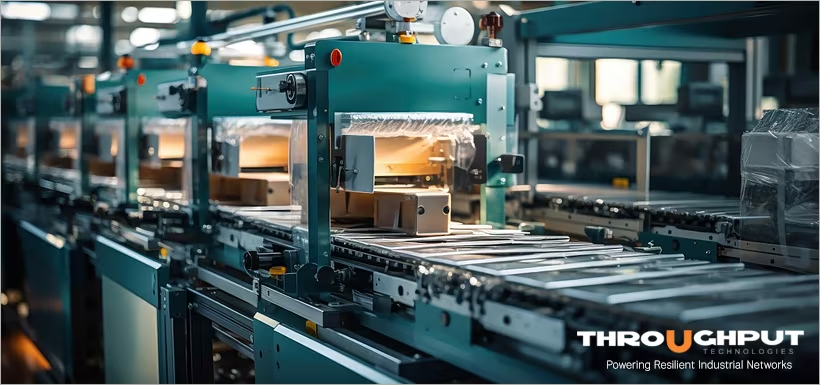
Between operational systems and enterprise platforms lies a boundary that is often poorly defined: the edge. This is where deterministic control meets flexible IT, and where many otherwise reliable networks begin to behave unpredictably.
Edge intelligence and data conversion exist to manage this transition deliberately. They preserve operational integrity while enabling data to move upward, outward, and onward - without destabilising the systems that must keep running. This section explains how to design that boundary with intent, not accident.
Edge intelligence is often described in terms of hardware: gateways, industrial PCs, embedded controllers. While devices play a role, the edge itself is not a product.
It is a conceptual boundary where real‑time meets non‑real‑time, deterministic systems interface with best‑effort systems, and raw signals are transformed into meaningful information. Treating the edge as “just another network node” ignores the complexity of what happens there - and why it matters. Edge design is architectural, not merely component‑based.
PLCs, RTUs, protection relays, and controllers are designed to run processes - not to answer ad hoc queries.
They operate on fixed cycles, with well‑defined communication patterns and limited tolerance for disruption. Naive approaches - polling everything, mirroring traffic indiscriminately, or exposing control devices directly to higher‑level systems - often lead to instability. Edge intelligence exists to mediate between these worlds, ensuring that data extraction does not become an operational risk.
Data conversion is frequently misunderstood as simple protocol translation: converting Modbus to MQTT, serial to Ethernet, or fieldbus to TCP/IP.
While format conversion is part of the picture, it is not the most important part. True data conversion addresses context, timing, semantics, and validity. A value without context is noise. A value delivered too late is irrelevant. A value misinterpreted is dangerous. Edge intelligence ensures that data retains its meaning as it crosses system boundaries.
| Conversion Aspect | Challenge | Edge Intelligence Role |
|---|---|---|
| Context | A raw value (e.g., 42) is meaningless without units, scaling, timestamp, and source. | Attach metadata, normalise units, map to semantic data models. |
| Timing | Control‑cycle data is time‑sensitive; enterprise systems tolerate delay. | Decouple cycles, buffer intelligently, timestamp accurately. |
| Semantics | Different systems use the same term for different concepts (e.g., “status”). | Map terminology, translate state machines, ensure consistent interpretation. |
| Validity | Raw data may include errors, stale values, or diagnostic states. | Filter, validate, apply quality flags, handle exceptions. |
One of the core tensions at the edge is determinism. Operational systems depend on predictable timing. Enterprise systems do not - they tolerate delay, reordering, and retries.
Edge intelligence must isolate deterministic traffic from non‑deterministic consumers, buffer and rate‑limit data extraction, decouple control cycles from reporting cycles, and ensure that failure on one side does not propagate to the other. When this decoupling is done properly, operational systems remain unaffected - regardless of what happens upstream. When it is not, edge devices become choke points and single points of failure.
A common mistake in edge design is doing too much, too close to operations.
Edge intelligence is not about pushing analytics, dashboards, or decision‑making logic into the control layer. It is about placing processing at the right boundary. Edge processing is well suited for normalising data, filtering noise, aggregating values, translating protocols, and enforcing rate limits. It is poorly suited for control decisions that affect safety, logic that depends on continuous connectivity, or heavy analytics requiring frequent updates. Understanding this distinction is critical to maintaining system stability.
Many of the systems most in need of data extraction are also the least capable of supporting it.
Legacy devices may support limited protocols, lack security features, be sensitive to polling rates, or be impossible to modify. Edge intelligence allows these systems to participate in modern architectures without changing their behaviour. By terminating legacy communications locally and presenting a controlled, modern interface outward, the edge protects both sides of the boundary. This is not modernisation by replacement. It is modernisation by containment and translation.
The edge is often treated as optional - a convenience layer that can be added or removed without consequence.
In reality, once systems begin to depend on edge‑derived data, the edge becomes part of the operational architecture. This creates new design requirements: edge failures must not affect control, loss of connectivity must be handled gracefully, data integrity must be preserved across interruptions, and recovery must be predictable. Edge intelligence that fails loudly or unpredictably introduces more risk than it removes.
The edge is also a security boundary - often the point where OT networks are exposed to IT systems and external access paths are introduced.
Without careful design, the edge can become a conduit for lateral movement, data leakage, or unintended access to control systems. Secure edge design includes clear separation of trust zones, one‑way or brokered data flows where appropriate, strong identity and access controls, and monitoring of edge behaviour itself. Edge intelligence should reduce exposure - not concentrate it.
Edge decisions cannot be made in isolation. They must align with network segmentation, redundancy design, diagnostics, and cybersecurity architecture.
An edge device placed without architectural context often becomes a hidden dependency. When it fails or behaves unexpectedly, diagnosing the impact can be difficult. Edge intelligence works best when it is architecturally intentional, observable, replaceable, and understood by operations. This alignment ensures the edge serves the larger system - not just a local requirement.
Not all data is useful. Not all data should be extracted. One of the most important edge decisions is deciding what not to move.
Blindly extracting all available data increases complexity, consumes network capacity, creates maintenance burden, and obscures what actually matters. Edge intelligence enables selectivity. It supports intentional data flows aligned with real use cases, not hypothetical future needs. Clarity beats completeness. This discipline prevents the edge from becoming a data landfill.
This section exists to help readers understand the edge as a system boundary, recognise the risks of uncontrolled data extraction, and design architectures that preserve operational integrity.
Edge intelligence and data conversion are not about making OT systems “smarter.” They are about making decisions smarter - without destabilising the systems those decisions depend on.
Throughput Technologies approaches edge intelligence as an architectural discipline. We focus on decoupling deterministic control from non‑deterministic consumption, translating data without losing meaning, and designing boundaries that reduce risk rather than concentrate it.
Modernisation succeeds when it respects continuity. The edge enables evolution - not revolution - by containing change where it belongs.
Edge intelligence interacts directly with protocols, architecture, diagnostics, cybersecurity, and standards. These related Knowledge Hub sections provide deeper context.
Foundational language - everything builds on this. How industrial protocols behave: timing, determinism, addressing, resilience, and longevity. Not trends - what lasts.
How things are actually designed to survive. Resilience through architecture - not device duplication. Redundancy models, segmentation, and operational resilience.

Security as architecture, not bolt‑on. Segmentation, access control, remote connectivity, and visibility boundaries in environments never intended to be connected.