
Factory Floor Networks
Industrial Ethernet networks connecting machines, sensors, and controllers – addressing latency, determinism, and environmental constraints on the production floor.
Manufacturing environments rely on deterministic, resilient networks to keep production moving. From PLC control and machine automation to plant-wide data visibility – network reliability, latency, and integrity directly impact output, quality, and safety.
Modern manufacturing networks connect machines, controllers, sensors, and supervisory systems into tightly coordinated production environments. Programmable Logic Controllers, distributed I/O, drives, safety systems, and industrial PCs exchange time-sensitive data that governs process control, motion, and sequencing. These networks must deliver predictable performance while operating continuously under harsh industrial conditions.
Manufacturing facilities increasingly blend operational technology with information systems. Production data flows upward into Manufacturing Execution Systems and enterprise platforms, while configuration and diagnostics flow downward to machines. This convergence increases visibility and efficiency, but also introduces new risks. Network design must preserve determinism on the factory floor while controlling access, segmenting traffic, and maintaining operational independence from corporate IT systems.
Manufacturing networks must tolerate faults without stopping production. Planned maintenance, unplanned failures, and cybersecurity incidents should not cascade into plant-wide downtime. Architectural considerations include segmented cell networks, deterministic Ethernet, resilient topologies, industrial-grade hardware, and clear separation between control, monitoring, and business systems. The objective is stable operation first – optimisation follows reliability.
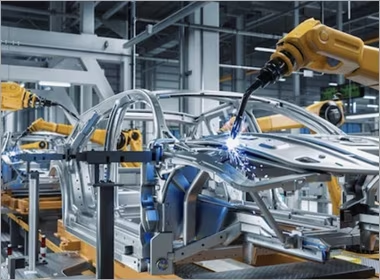
Industrial Ethernet networks connecting machines, sensors, and controllers – addressing latency, determinism, and environmental constraints on the production floor.
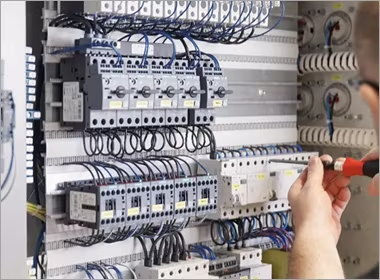
Networking PLCs, distributed I/O, and control systems – architecture choices affecting reliability, response time, and maintainability.
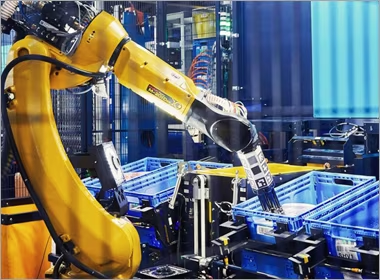
Enabling reliable data exchange between machines – protocol interoperability, timing constraints, and scalable production architectures.

Securing manufacturing networks – segmentation, controlled access, resilience strategies, and maintaining production during incidents.
Throughput Technologies works with industrial networking specialists supporting manufacturing environments. Westermo provides rugged industrial Ethernet switches designed for continuous operation on factory floors. ATOP Technologies delivers secure switching and protocol support for automation and control systems. ProSoft Technology enables interoperability between diverse PLC platforms and legacy equipment. Welotec edge computing solutions support local data processing and industrial analytics. Secomea allows controlled remote access for diagnostics and maintenance without exposing production networks.
Manufacturing performance depends on network stability. Before optimisation initiatives such as analytics, digital twins, or cloud integration can succeed, the underlying network must deliver predictable behaviour under all operating conditions. A well-designed manufacturing network provides a stable platform for gradual improvement, supporting production continuity, quality control, and safe operation as systems evolve.
Each topic above examines a core aspect of manufacturing network design, offering practical guidance for automation engineers, plant managers, and network architects responsible for reliable production environments.