
Factory Floor Networks
Designing robust industrial Ethernet, safety systems, wireless networks, and segmented architectures for manufacturing cells, machines, and mobile equipment.
M2M networks transform isolated machine data into coordinated intelligence, enabling predictive maintenance, real-time quality control, and production optimization - provided the underlying connectivity handles industrial timing, volume, and security demands.
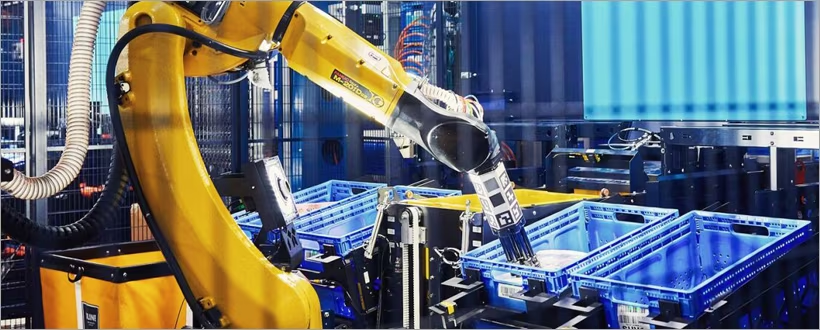
Machine-to-machine communication operates at the intersection of real-time control data and high-volume analytics traffic, where network design determines whether data becomes insight or interference.
Traditional manufacturing networks carried cyclic I/O and controller data with predictable timing and volume. M2M adds acyclic data streams: vibration analytics from motors, thermal images from inspections, quality measurements from vision systems, and equipment health telemetry. These flows have different characteristics - bursty, high-volume, time-sensitive for analysis but not necessarily for control. Network infrastructure not designed for mixed criticality suffers when data peaks during production shifts, causing packet loss, increased latency, and ultimately, lost insights.
Effective M2M connectivity starts with traffic profiling: identifying which machines communicate, what data they generate, at what frequency, and where it needs to go. Vibration data might be streamed continuously at 1 kHz for analysis, while quality results are sent batch-wise every minute. Network switches, bandwidth, and topology must accommodate both continuous flows and burst traffic without impacting deterministic control traffic sharing the same infrastructure.
OPC UA provides structured information modeling and security, while MQTT offers lightweight publish - subscribe messaging - choosing the right protocol depends on data structure, network constraints, and integration endpoints.
OPC UA is the standard for semantic data modeling in industrial automation, allowing machines to share not just values but context (units, ranges, relationships). Its client-server architecture suits supervisory communication but can be heavy for constrained edge devices. MQTT, using a broker-based publish-subscribe model, is efficient for distributing telemetry from many devices to many subscribers, ideal for cloud integration. However, MQTT alone lacks the built-in semantic modeling of OPC UA.
In practice, hybrid architectures emerge: OPC UA at the machine and cell level for rich contextual data exchange, with MQTT bridges forwarding condensed telemetry to cloud platforms. Gateways such as those from Welotec can perform protocol translation, data filtering, and compression, reducing upstream bandwidth. Network design must account for protocol overhead, connection persistence (MQTT keep-alives), and broker placement—on-premise brokers reduce cloud dependency and latency for critical alerts.

Edge computing nodes process machine data locally, reducing upstream bandwidth and latency, but require robust network connectivity to adjacent machines and central systems.
Edge computing moves analysis closer to machines to reduce latency and bandwidth, but creates distributed network points that require careful integration and security.
Placing compute at the edge - near PLCs, robots, or inspection stations - allows real-time analytics: detecting tool wear from motor currents, identifying defects from camera images, or calculating OEE locally. This reduces the volume of raw data sent upstream but increases network complexity. Edge devices need reliable connectivity to source machines (often via industrial Ethernet) and to central systems (via plant backbone). They also require remote management, software updates, and security monitoring.
Network design for edge computing considers location, connectivity redundancy, and segmentation. Edge nodes in harsh environments may require ruggedized hardware and fiber connections for electrical isolation. Data flow is often bidirectional: configurations and models flow down, processed insights flow up. Quality of Service (QoS) ensures management traffic doesn't interfere with real-time analytics. Implementing zero-trust principles, even at the edge, prevents compromised nodes from affecting wider networks.
Predictive maintenance relies on high-frequency sensor data aggregated from multiple machines, demanding networks that handle sustained data streams without packet loss.
Vibration sensors, ultrasonic detectors, thermal cameras, and motor current monitors generate continuous time-series data. A single vibration sensor sampling at 10 kHz produces megabytes per hour. Multiply this across dozens of critical assets, and network capacity becomes a constraint. Loss of packets means loss of frequency components needed for accurate fault detection.
Networks for predictive maintenance often use a tiered approach: sensors connect via IO-Link or direct analog to local gateways; gateways perform initial filtering and FFT (Fast Fourier Transform), reducing data volume before transmission over the backbone. Time synchronization (IEEE 1588) ensures data from multiple sensors can be correlated accurately. For critical assets, redundant network paths ensure continuous data flow. Storage and analysis platforms need high-throughput connections, often 10 GbE links to handle aggregated streams.
Vision systems generate high-bandwidth image and video data with strict latency requirements for real-time pass/fail decisions and feedback to control systems.
Modern inspection systems use multi-megapixel cameras capturing hundreds of frames per second. Each image might be several megabytes, creating gigabit-per-second data loads. This data must travel from cameras to processing units (often industrial PCs or dedicated vision controllers), then results (pass/fail, measurements) to PLCs or MES. Network latency directly impacts line speed - delayed reject signals can miss defective products.
Dedicated VLANs for vision traffic prevent interference from other data. Jumbo frames (MTU 9000) improve throughput for large image packets. Placement of processing nodes is critical: on-camera processing reduces bandwidth but increases cost; centralized processing requires high-capacity backbone links. Integration with control networks often uses OPC UA or direct Ethernet/IP tags. Security is vital - vision systems are increasingly targeted as they provide insight into product quality and proprietary designs.
Monitoring energy consumption across machines, lines, and facilities creates numerous low-bandwidth but high-persistence data streams that require reliable collection over years.
Smart meters, power monitors, and sub-metering devices measure voltage, current, power factor, and energy usage at multiple points. Data intervals range from seconds to minutes, creating many small, periodic packets. While individually low bandwidth, collectively they create steady network load. More importantly, data integrity over long periods is essential for identifying trends, calculating carbon footprints, and verifying efficiency projects.
Networks for energy data often use industrial Ethernet or wireless mesh to connect meters in hard-to-wire locations. Time-stamping ensures consumption can be correlated with production schedules. Data aggregation at local gateways reduces connection counts to central systems. Integration with building management systems (BMS) and enterprise sustainability platforms requires protocol translation - Modbus TCP to MQTT or OPC UA - handled by gateways from partners like ProSoft Technology or Welotec.
Connecting machine data to enterprise systems bridges operational technology with business planning, but requires secure, reliable data exchange across network boundaries.
Manufacturing Execution Systems (MES) need real-time production counts, quality results, and equipment status. Enterprise Resource Planning (ERP) systems require aggregated data for planning, scheduling, and costing. This integration crosses the OT/IT boundary, presenting security and performance challenges. OT networks prioritize determinism and uptime; IT networks manage bandwidth and security differently.
The industrial demilitarized zone (IDMZ) architecture provides a secure buffer between zones. Data diodes or unidirectional gateways can send data from OT to IT while preventing any return traffic that could carry threats. OPC UA with its built-in security features is often the protocol of choice for cross-zone communication. Network design must ensure sufficient bandwidth for data bursts during shift reporting and end-of-day summaries without affecting control traffic.
Throughput Technologies advises on industrial M2M connectivity architectures that balance real-time control needs with high-volume data flows, enabling predictive maintenance, quality assurance, and enterprise integration.
Talk with a Solutions Specialist to design your machine-to-machine data network.
Use OPC UA when you need rich contextual data (metadata, hierarchies, historical access) and have the network capacity for its larger overhead. It's ideal for machine-to-machine communication within the control layer and for SCADA integration. Choose MQTT for lightweight telemetry from many devices to cloud platforms, especially over constrained or unreliable networks. In practice, a gateway can bridge both: OPC UA collects full-context data from machines, then an MQTT client publishes condensed telemetry to the cloud. This preserves semantic richness at the source while optimizing for wide-area transmission.
Raw vibration data from a single accelerometer sampling at 10 kHz with 16-bit resolution generates 20 kB/s. With three axes, that's 60 kB/s per sensor. Dozens of sensors can produce multiple megabytes per second continuously. However, most systems don't transmit raw data continuously. Edge processing performs Fast Fourier Transform (FFT) locally, sending spectrum peaks (a few kB per minute) instead. This reduces bandwidth by 99%+. Network design must support raw data bursts during detailed analysis periods and steady spectrum data for continuous monitoring. Always overspecify bandwidth - Gigabit links for aggregation points are now standard.
Implement security at multiple layers. Use network segmentation (VLANs) to isolate M2M traffic from other networks. Employ transport-level encryption (TLS 1.3 for OPC UA, MQTT over TLS) which adds minimal latency on modern hardware. At the device level, use certificate-based authentication instead of passwords. For especially sensitive data, consider application-layer signing. Performance impact from encryption is typically less than 5% latency increase on capable hardware - a worthwhile trade for security. Regular key rotation and certificate management are essential; automated systems from partners like Secomea can help manage this at scale.
A hybrid star-ring topology often works best. Edge nodes connect in a star to local switches near machine groups, ensuring short cable runs and easy isolation. These local switches then connect via fiber rings to central aggregation switches, providing redundancy. This balances fault containment with resilience. Each edge node should have dual power supplies and network connections if critical. Management VLANs separate configuration traffic from data flows. Physical location matters—place edge nodes in protected enclosures with proper cooling, but as close as possible to source machines to minimize analog signal degradation.
Retrofit with protocol gateways that tap into existing signals. For machines with PLCs but no Ethernet, add a serial-to-Ethernet converter (like ProSoft RLX2 series) to expose data via Modbus TCP. For machines without any digital interface, add sensors (current clamps, vibration sensors) with IO-Link masters that connect to Ethernet. For proprietary systems, consult the OEM for data access options—many offer upgrade kits. The key is to start with the most valuable data points (runtime, cycle counts, fault codes) rather than trying to capture everything. Gradual implementation allows network capacity planning and validation of data usefulness before scaling.
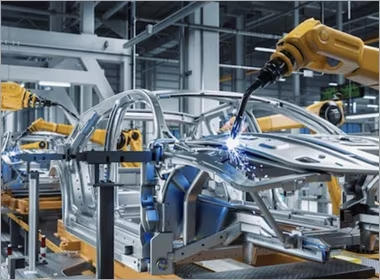
Designing robust industrial Ethernet, safety systems, wireless networks, and segmented architectures for manufacturing cells, machines, and mobile equipment.
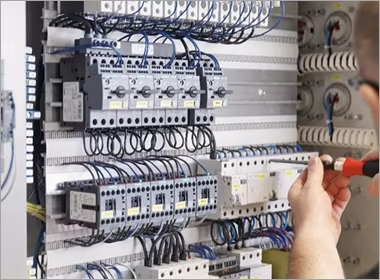
Networking for deterministic control, motion coordination, legacy fieldbus integration, and redundancy in continuous manufacturing processes.

Protecting production networks from cyber threats while ensuring operational continuity through segmentation, secure remote access, and resilient design for 24/7 manufacturing operations.