
Network Architecture & Redundancy
How industrial networks are designed to survive through architecture, segmentation and validated resilience.
Port terminal systems have different operational purposes, criticality and ownership. Where they communicate across shared infrastructure, the network boundaries must be deliberately engineered, not assumed from physical proximity or a single segmentation model.
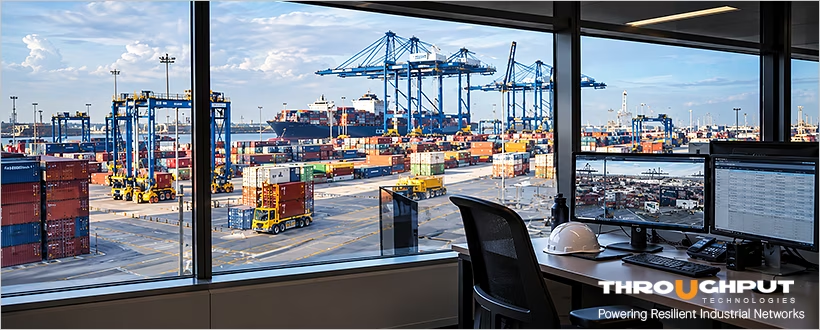
A port terminal brings together operational areas whose systems must communicate while retaining separate requirements and responsibilities.
The boundary is not the VLAN. It is the defined, controlled and monitored relationship between systems that must communicate, and between the people responsible for them.
A terminal is not one system. It is a collection of systems that must work together.
A port terminal may depend on a terminal operating system, gate and access control, yard and crane automation, equipment monitoring, CCTV and security, fire systems, weighbridges, reefer monitoring and operational communications. These systems may have different operational owners and support arrangements.
Not every terminal uses the same systems or the same architecture. The combination is determined by the terminal's function, its age, its commercial model and its investment history. The engineering problem is not the specific list of systems. It is that these systems must communicate across shared infrastructure while retaining their distinct operational requirements.
Shared infrastructure does not mean shared requirements.
Systems that share a physical network do not share an operating domain. They differ in operational purpose, availability requirement, traffic pattern, latency sensitivity, security exposure, support arrangement, data dependency and the consequence of interruption.
The differences are specific to the terminal and the system. A gate operating system may have stringent availability requirements during a vessel discharge window and more tolerance during a quiet period. A crane automation system's tolerance for interruption depends on its operating mode, the level of automation, and whether a human operator is present to intervene. A terminal operating system may exchange work instructions, task assignments, or status information with other systems rather than direct control commands. These are illustrative differences, not universal rules. The engineering point is that the requirement must be established for the actual system, in the actual terminal, in the actual operating condition.
Placing two systems on the same network does not make their requirements the same. It makes the network the place where their different requirements must be reconciled.
A boundary is a controlled relationship, not a physical separation.
Network segmentation is a useful control. VLANs, subnets and physical separation can limit broadcast domains and reduce unnecessary traffic. But segmentation is one control among several. It does not, by itself, define what communication is permitted, who authorises it, how it is monitored, or who is responsible when it fails.
A complete network-boundary design includes:
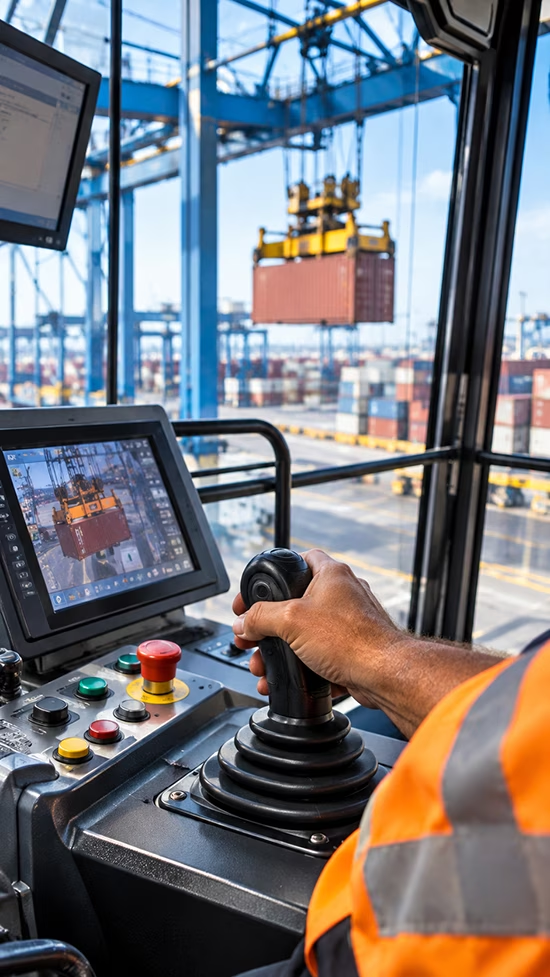
Crane control depends on reliable communication between the operator, control station and equipment.
A VLAN may be part of the mechanism. It is not the boundary. The boundary is the engineered, documented and operated relationship between systems that must communicate.
A permitted connection must be understood, not merely allowed.
Where two systems must exchange information or services, the connection must be defined as an interface. The interface definition must establish the engineering information needed to manage it:
An interface that is permitted without this definition is an interface that cannot be monitored, changed or faulted with confidence. The engineering question is not only whether the communication works. It is whether the communication is the communication that was intended, whether it is the only communication that is permitted, and whether its failure can be detected and attributed.
A technical boundary is not automatically an ownership boundary.
A terminal may have a network architecture that segments gate operations, yard automation and the terminal operating system into distinct zones. The architecture may be technically correct. But if the gate system is owned by one operational team, the yard automation by another, and the terminal operating system by a third, the boundary between them is also an organisational boundary.
The ownership model must distinguish three responsibilities that are often conflated:
Where these three responsibilities are not defined, the gap becomes an operational risk. The boundary must be designed so that the people responsible for each side can operate it. That means the interface must be agreed between them, the monitoring must be visible to both, and the fault-coordination procedure must be understood by both.
The architecture must remain understandable as the terminal changes.
A terminal network is not designed once and operated unchanged. Systems are added, suppliers change, operational requirements shift and infrastructure is renewed. The architecture must remain understandable through those changes.
This requires architecture documentation that reflects the actual network, not the network as designed. It requires configuration control that records what changed and why. It requires an approved-change process that considers the boundary implications of any change. It requires monitoring that can detect a change in behaviour before it becomes a fault. It requires fault isolation that can identify which boundary is involved. It requires recovery procedures that restore the intended state, not merely the connection.
The engineering outcome is a network architecture that can be operated, maintained and extended without losing the boundaries that make it manageable.
The boundary is the relationship, not the device.
Port terminal systems cannot be treated as one undifferentiated communications environment. They have different purposes, different owners and different requirements. Where they share infrastructure, the boundaries between them must be deliberately engineered.
That means defining the permitted communication, enforcing it with access control, observing it with monitoring, documenting the ownership, and coordinating the faults. Segmentation is one control within that design. It is not the design.
A terminal that has segmented its network without defining these relationships has created the appearance of a boundary without the operational substance. A terminal that has engineered the boundary has improved its ability to operate, change and diagnose the network, but it has not automatically established that the entire network can be trusted. Trust is established through the ongoing operation of the boundary, not through a single design exercise.
Where a terminal's systems are connected but the boundaries between them are not fully defined, a specialist architectural assessment may establish what is missing and what must be resolved before the next change or expansion.
How do you know whether a connected port is properly controlled?
Port terminal systems cannot be treated as one undifferentiated communications environment. Where they share infrastructure, the boundaries between them must be deliberately engineered.
How do you know whether a connected port is properly controlled?
If the boundaries between your terminal systems are unclear, or the interface ownership is undefined, Connect with a Solutions Specialist to discuss how to establish controlled, documented and operable network boundaries.
No. Segmentation is a technical control that separates traffic into logical or physical groups. A network boundary is the engineered relationship between systems: what communication is permitted, how it is enforced, how it is observed, who owns it and how faults are coordinated. Segmentation may be part of the boundary. It is not the boundary. A terminal can have segmented its network and still have no defined permission for what may cross between the segments, no monitoring of what is actually crossing, and no agreement on who is responsible when a cross-segment dependency fails. The segmentation is the mechanism. The boundary is the engineered, documented and operated relationship.
No. IEC 62443-3-2 describes a risk-based approach to grouping assets into zones according to their security requirements and risk criteria. It describes conduits as the logical grouping of communication channels that share common security requirements between zones. The standard provides a structured model for thinking about the relationship between assets and the communication between them. It does not prescribe one architecture for every terminal. The risk assessment determines the groupings. The architecture and the associated controls determine which communications are permitted. A terminal with a different operating model or risk profile may group its assets differently and may define its conduits differently. The standard provides the method, not the answer.
The ownership must be defined explicitly across three responsibilities. The first is the network infrastructure: who operates the physical and logical network that carries the traffic. The second is the connected systems: who supports the application and equipment at each end. The third is the interface between them: who is responsible for the defined communication service that connects the two systems. The third responsibility is frequently undefined. Two organisations can each understand their own systems and still have no agreed responsibility for the communication between them. When a change is proposed, the interface owner must be identified. When a fault occurs, the interface owner must be identified. When the service is restored, the interface owner must be identified. The ownership must be documented and agreed by both sides, and it must be reflected in the monitoring and fault-coordination procedures.
At minimum, the definition must establish the system and application at each end, the purpose and nature of the exchange, the protocol and permitted direction, the required availability and the behaviour during interruption, who authorises and supports the interface, and how the interface is monitored and faults are isolated. The technical characteristics and the operational characteristics must both be agreed by the owners of the systems at each end. The interruption behaviour must be agreed by both sides: what the sending system does when the interface is unavailable, and what the receiving system does. The fault attribution must be agreed by both sides: how the evidence is collected, how it is shared, and how the investigation is coordinated. An interface that is defined by one side only is not a complete definition.
No. Engineering the boundary establishes that the communication is defined, enforced, observed and owned. It does not establish that the network can be trusted. Trust is established through ongoing evidence: monitoring that shows the boundary is operating as defined, configuration control that shows the boundary has not changed unexpectedly, and operational discipline that shows the fault-coordination procedure is followed when a fault occurs. A boundary design is a necessary condition for trust. It is not a sufficient one. The sufficient condition is the ongoing operation of the boundary, with evidence that it continues to operate as intended.
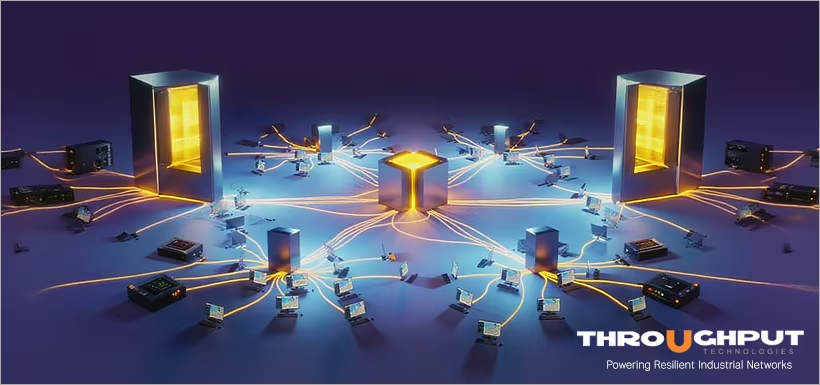
How industrial networks are designed to survive through architecture, segmentation and validated resilience.

Security as architecture – controlled access, segmentation, visibility and defined boundaries.
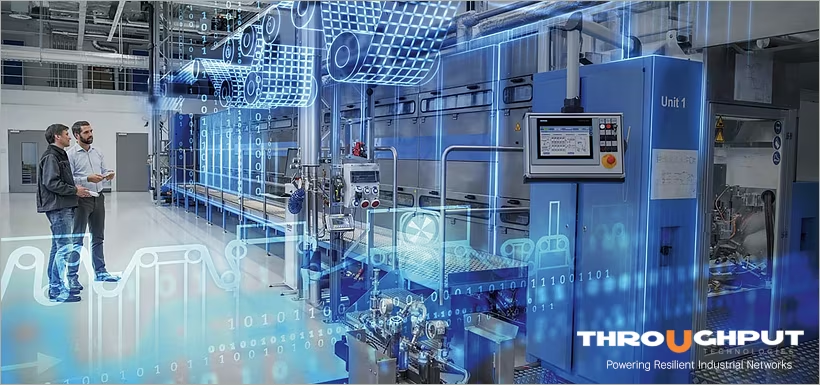
Understanding what the network is doing, detecting degradation and finding evidence before failure.