
Protocols & Industrial Communications
Rail networks have been designing for deterministic behaviour for decades. Utilities are increasingly confronting the same operational availability questions that rail has long had to answer.

What Rail Can Teach Utilities About Operational Availability
Rail networks have been designing for deterministic behaviour for decades. Utilities are increasingly confronting the same questions.
Availability depends on how the network behaves when conditions change.
Rail and utility networks operate in very different environments. One moves people and freight across a defined corridor. The other protects and distributes electrical power across geographically dispersed infrastructure. Yet both depend on communications systems that must continue performing when equipment fails, links are interrupted, maintenance is underway or operating conditions change.
The important lesson is not that utilities should build railway networks.
It is that rail has already learned to treat communications behaviour as part of operational availability.
Availability Means More Than Keeping Equipment Running
An available system is not simply one in which every device remains powered and connected.
Rail signalling and communications systems operate within environments where a short interruption can have consequences well beyond the network itself. The engineering therefore considers what happens when communication paths change, equipment fails or systems transition between states.
Utilities face increasingly similar requirements. Protection systems, substation automation, SCADA, remote monitoring and operational communications depend upon information arriving when it is required and behaving predictably when the network is disturbed.
A network can remain technically operational while the process it supports is already being affected.
That distinction is fundamental to operational availability.
The Real Test Begins When Something Changes
Normal operation tells engineers that the network works. A disturbance reveals how well it was engineered.
A redundant network may provide an alternative path after a link failure. The engineering question is what happens during the transition.
How quickly does communication recover? Which systems are affected? Do critical devices restart or reconverge in the expected sequence? Does traffic follow the intended path? Can the engineering team see what happened afterwards?
These questions move availability away from a simple uptime calculation and towards predictable operational behaviour.
Rail engineering has long had to consider this behaviour because the consequences of communication disruption can extend into signalling, train movement and network operations. Utilities increasingly face comparable requirements as substations become more automated and operational dependence on communications grows.
Deterministic Behaviour Matters
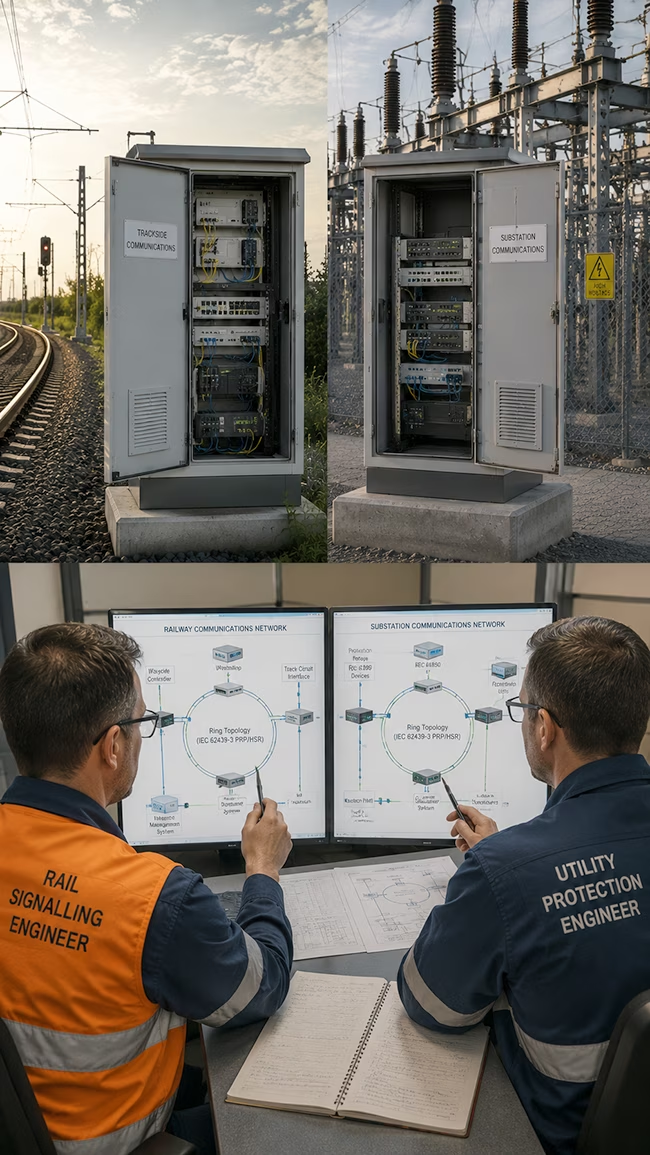
Communications equipment in rail and utility environments
The objective is not merely to move data. It is to know how the network will behave when the expected path is no longer available.
Deterministic behaviour is particularly important where communication timing influences the operation. Latency, jitter, recovery behaviour, traffic prioritisation and network topology can all affect how systems respond to changing conditions.
Rail provides a useful engineering reference because communications have historically been designed around operational consequences rather than connectivity alone. The network is part of a controlled operational environment, and its behaviour must be understood under normal and abnormal conditions.
Utilities are moving in the same direction.
Modern substations increasingly integrate protection, control, monitoring and communications through standards such as IEC 61850. The engineering guidance within that standard explicitly addresses topology, redundancy, clock synchronisation and network engineering for protection and control. As more operational functions depend upon network communications, the distinction between "the network is up" and "the network is behaving correctly" becomes increasingly important.
Redundancy Is Only The Starting Point
Two paths do not automatically provide two reliable paths.
Rail has extensive experience with redundant communications architectures, but redundancy is only useful when the network can transition between paths in a manner compatible with the systems it supports.
The same principle applies within utility networks.
A duplicated link, additional switch or alternative route may increase theoretical availability without necessarily improving operational resilience. Recovery mechanisms, topology, device behaviour and application requirements must work together.
This is where engineering discipline becomes more important than equipment count.
The question is not:
How much redundancy has been installed?
It is:
What happens when the primary path disappears?
That answer should be established during design rather than discovered during an outage.
Design For The Failure, Not Just The Normal
The strongest availability strategies are tested against the conditions they are intended to survive.
Rail networks cannot design only for clear track, functioning equipment and uninterrupted communications. Their operating environments inherently require consideration of failure, maintenance, disruption and degraded conditions.
Utilities face their own equivalent conditions: equipment failure, storms, switching operations, fibre interruptions, power disturbances, maintenance and changes to network configuration.
Designing for these events does not mean expecting failure everywhere. It means understanding how the architecture behaves when failure occurs.
This changes how networks are assessed.
Instead of asking whether every component is healthy, engineers can ask whether the system remains operationally correct when individual components are not.
That is a much stronger definition of resilience.
Operational Availability Depends On Visibility
An operation cannot maintain availability it cannot observe.
Rail engineering also demonstrates the importance of knowing what happened, not merely knowing that something went wrong.
When a communications event occurs, engineers need sufficient information to establish the sequence of events, identify the affected systems and determine whether the network behaved as designed. Without that visibility, intermittent faults become recurring investigations and operational teams are left reconstructing events after the fact.
Utilities face the same challenge as networks become larger, more distributed and more dependent upon communications.
Monitoring therefore becomes more than an alarm function. Baselines, event records, timing information and network diagnostics provide the operational memory required to understand network behaviour.
A green status indicator can confirm that a device is communicating.
It cannot necessarily explain whether the network is behaving as it should.
The Lesson Is Not To Copy Rail
The value of rail experience lies in the engineering principles behind it, not in reproducing a railway architecture inside a utility.
Utilities have their own protection requirements, operating models, regulatory environments and physical infrastructure. Their architectures must be engineered accordingly.
The transferable lesson is the discipline of designing communications around operational consequences.
Rail asks what happens when communications change because the answer can affect the movement of a train.
Utilities must increasingly ask the same kind of question because communications can influence protection, control, monitoring and the wider continuity of power operations.
The technologies may differ.
The engineering question does not.
From Connectivity To Operational Availability
The next stage of industrial networking is not simply greater connectivity. It is greater confidence in how that connectivity behaves.
Rail demonstrates what happens when communications are treated as operational infrastructure rather than supporting technology. Utilities are increasingly reaching the same point as digital substations, remote operations and interconnected control systems increase their dependence on reliable communications.
Operational availability therefore begins before equipment is selected.
It begins with understanding the operation, identifying the consequences of communication failure and designing an architecture whose behaviour under those conditions is known.
That is the lesson worth carrying from rail into utilities.
A network is not resilient because it has survived normal operation. It is resilient when its behaviour during disruption is understood, engineered and predictable.
Related Engineering
Continue exploring the engineering disciplines that determine operational availability.
Related Industries
Explore how these principles apply across different operational environments.