
The Last Mile Problem in Industrial Networks
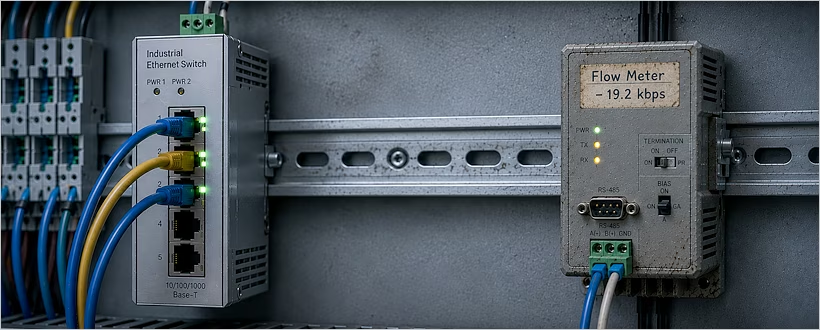
Your backbone runs at gigabit speed. Your switches forward frames in microseconds. Your SCADA polls on schedule. None of that matters if the last metre is serial.
The Performance Illusion That Traps Engineers
Engineers measure backbone utilisation. They monitor switch latency. They track SCADA response times. The numbers look good. The system feels slow.
The gap is not in the backbone. It is in the field. A flow meter publishing once per second over RS-485. A VFD responding to polling every 500 milliseconds. A legacy RTU that cannot handle simultaneous requests.
Each device is individually adequate. Together, they create a cumulative delay that no backbone upgrade can fix.
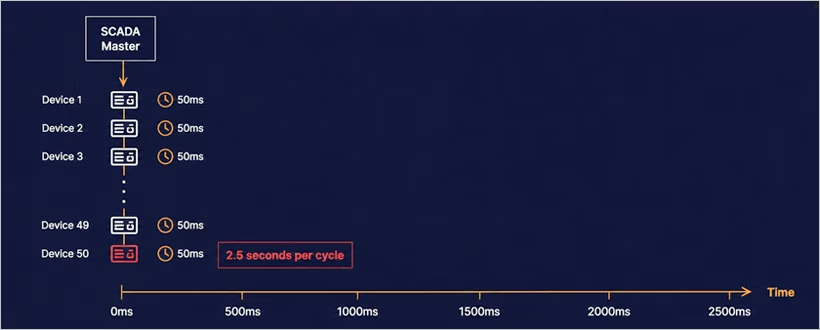
The math is simple but brutal. A SCADA master polls fifty serial devices sequentially. Each device takes 50 milliseconds to respond. Add polling overhead. The cycle time exceeds 2.5 seconds before any backbone latency is added. The operator watches a screen that updates every three seconds. The process changes faster than the display.
SCADA is not the bottleneck. The field layer is.
Why Bandwidth Upgrades Do Nothing
Adding fibre does not make a serial device faster. Upgrading from 1 Gbps to 10 Gbps does not change Modbus polling intervals. The backbone is not the constraint.
The field layer operates at speeds designed in the 1980s. 9.6 kbps. 19.2 kbps. 115.2 kbps if the site is lucky. Meanwhile, SCADA polls dozens of these devices sequentially. Each request waits for the previous response. The delays add up.
A backbone upgrade reduces transmission time from 1 millisecond to 0.1 milliseconds. That improvement is irrelevant when the field device takes 50 milliseconds to respond.
Engineers who spec 10 Gbps backbone switches while leaving 19.2 kbps field devices in place are optimising the wrong layer. The backbone is not the problem. The last mile is.
The Hidden Cumulative Delay
The problem compounds across multiple field segments. A single RTU with thirty serial devices connected via daisy-chained RS-485 creates a polling cascade.
The SCADA master polls the RTU. The RTU polls device one, waits, polls device two, waits. Each additional device adds latency. When the site adds a new sensor, the engineer adds it to the existing polling chain. The cycle time extends. No one notices until the SCADA update rate degrades from 2 seconds to 4 seconds.
By then, the system has normalised the slow performance. Operators accept it. The root cause remains hidden. The backbone continues to run at gigabit speed. The field layer continues to crawl.
The Edge Gateway Solution That Breaks The Bottleneck
Smart architectures do not replace legacy field devices. They isolate them.
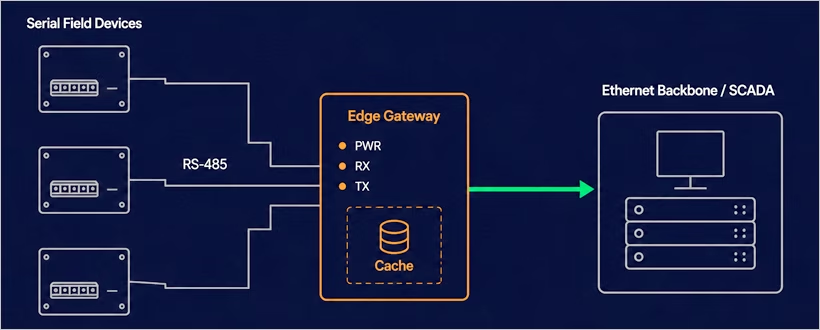
An edge gateway sits between the serial field network and the Ethernet backbone. It polls the serial devices locally – at their native speed. It caches the data. Then it serves that data to SCADA and IIoT platforms over high-speed Ethernet at gigabit rates.
The gateway decouples the field polling rate from the backbone transmission rate. SCADA sees fresh data without waiting for serial response times. The field devices continue operating as they always have.
The improvement is immediate. A site with fifty serial devices polled sequentially at 50ms each sees a SCADA update cycle of 2.5 seconds. Deploy an edge gateway that polls those same fifty devices in parallel – each on its own schedule – and the gateway serves the latest values to SCADA in milliseconds.
The Protocol Translation Advantage
Protocol translation adds another dimension of improvement. A Modbus device does not need to become OPC UA. It needs a gateway that speaks Modbus on one side and OPC UA on the other.
The gateway maps registers to information models. Raw values gain context – units, quality, timestamps. The field device does not change. The data that leaves the gateway is transformed.
A temperature sensor publishing raw register 40001 becomes a data point labelled "Reactor Temperature – 78.2°C – Quality Good – 14:23:05." No manual mapping. No interpretation errors. No custom scripting.
Interestingly, ProSoft Technology builds gateways that execute this translation. A legacy PLC continues running its original program. The gateway makes its data available to modern clients without reprogramming, without downtime, without risk. The field device never knows it is being translated. The enterprise system never sees the raw register.
The Three-Tier Migration Framework
Not all devices need replacement. Not all protocols need translation. The framework has three tiers.
Tier 1 – Direct Integration. Devices already speaking Ethernet with acceptable performance stay as-is. No intervention required.
Tier 2 – Edge Gateway. Serial devices with long remaining life get a gateway. Performance improves without replacement. The gateway handles polling, translation, and data caching. The device continues its original function.
Tier 3 – Replacement. Devices at end-of-life or with unacceptable performance get replaced with native Ethernet versions.
The key is intentionality. Most sites default to Tier 3 because they do not know Tier 2 exists. The result is unnecessary capital expenditure and unnecessary downtime. A site with fifty healthy serial devices does not need fifty replacements. It needs one gateway.
Operational Impact of Solving the Last Mile
Organisations that solve the last mile problem see measurable improvements.
SCADA update rates improve from seconds to milliseconds. Operators see real-time data. Alarms arrive without delay. Decisions are based on current conditions, not stale values.
Backbone utilisation drops because polling traffic is localised to the edge gateway. The backbone carries only the data SCADA requests, not every polling transaction.
Engineering hours shift from troubleshooting polling delays to designing better architectures. The legacy devices remain in service. The site avoids unnecessary replacement costs.
The Question Most Sites Never Ask
Walk your facility. Identify every serial device. Measure its polling interval. Calculate the cumulative delay from field to SCADA.
Then ask: how much of that delay would disappear with an edge gateway – without replacing a single field device?
The last mile problem is solvable. But not with backbone upgrades. Not with faster switches. Not with more bandwidth.
The solution is at the edge.
BREAK THE LAST MILE BOTTLENECK
Throughput advises on edge gateway architectures that isolate legacy serial devices and deliver modern performance without replacement.
Talk with a Solutions Specialist
Where is your last mile limiting your throughput –
and how much delay is that costing your operation?