
WESTERMO: Definitive Industrial Networking Partner
Westermo designs industrial networking platforms engineered for deterministic communication, long lifecycle operation, and stable performance in electrically and physically demanding environments. These technologies are applied where network behaviour directly influences control systems, protection schemes, and operational continuity.
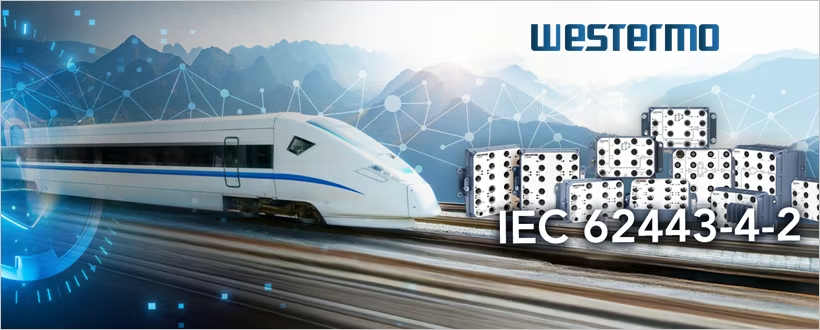
Deterministic Industrial Networks Built For Real-World Conditions
Westermo platforms are developed for environments where communication must remain predictable under failure, interference, and load.
Industrial networks do not fail under ideal conditions - they fail under stress. Westermo systems are designed to maintain controlled behaviour during those conditions, ensuring communication remains within defined limits.
This applies across:
The objective is not connectivity. It is predictable behaviour under real conditions.
Where This Applies
Rail & Transportation
EN 50155-compliant networking for onboard systems, signalling, train-to-ground communication, and trackside infrastructure.
Energy & Utilities
Substation automation, grid communication, and renewable energy networks operating under high EMI and long-distance fibre conditions.
Industrial & Process Environments
Mining, oil & gas, and manufacturing environments where physical and electrical stress require stable communication.
Infrastructure & Smart Systems
Road, tunnel, and distributed infrastructure where uptime and deterministic behaviour directly affect safety.
Explore Westermo Technologies

Industrial Ethernet Switching - Edge, Backbone And Core
Switching platforms define how traffic behaves, how failures are handled, and how stability is maintained.
Key Technologies and Capabilities
Industrial Routing & Secure Segmentation
Routing platforms define how networks are segmented, secured, and extended across distributed environments.
Supports:
Wireless Communication - Rail, Mobile And Distributed Systems
Wireless enables communication where fixed infrastructure cannot provide continuous or practical coverage. In rail and mobile environments, this is not an extension of the network - it is the network.
Extending Networks Over Existing Infrastructure
Not all environments allow fibre deployment. Legacy infrastructure must be reused without compromising performance.
Simple And Robust Industrial Connectivity
Not all applications require managed complexity, but they still require industrial reliability.
Edge Processing & Integrated Platforms
Some environments require communication and processing to operate as a single, coordinated system. This reduces dependency on central infrastructure and enables deterministic behaviour at the edge.
Network Behaviour, Redundancy & Control (WeOS)
The operating system defines how the network behaves, not just how it connects.
WeOS → Deterministic switching, redundancy protocols, security and diagnostics.
Key Product Families (Complete Structure)

How Westermo Fits Into Your Network Architecture
Westermo forms the communication backbone layer:
Integration Context
Westermo provides the stable communication layer onto which:
are built. Without stable network behaviour, these systems cannot operate predictably.
Cybersecurity In Industrial Networks
Security in industrial environments is achieved by controlling communication behaviour, not just restricting access at the perimeter.
Westermo addresses cybersecurity by embedding control directly into the network infrastructure, ensuring that communication is structured, segmented, and predictable across industrial systems. Rather than acting as a standalone cybersecurity vendor, Westermo enables secure network design through its switching, routing, and operating platform capabilities.
Segmentation is central to this approach. Using Layer 2 and Layer 3 controls, VLAN structuring, and routing policies, Westermo platforms restrict how devices communicate across zones. This prevents uncontrolled lateral movement and ensures that systems only interact where explicitly permitted. The result is a network where access paths are defined and enforced, not assumed.
Secure remote access is implemented without bypassing this structure. Through VPN-based connectivity and controlled entry points, remote communication is introduced in a way that maintains segmentation and does not expose critical systems.
Deterministic network behaviour further strengthens security. When communication patterns are stable and predictable, anomalies become easier to detect and investigate, supporting faster response to potential threats.
Westermo integrates into broader industrial cybersecurity architectures by providing the stable, controlled network layer required for firewalls, monitoring systems, and secure access platforms to operate effectively.
Where Is Your Communication Stability Assumed - But Not Guaranteed?
Throughput Technologies advises on the selection and application of industrial networking platforms aligned to system behaviour, environmental conditions, and long-term operational requirements.
Talk with a Solutions Specialist
What does your network need to do - and where is it falling short?