
Surface & Processing Plant Networks
Designing industrial networks for crushers, conveyors, processing plants, and surface infrastructure that withstand dust, vibration, and continuous operation.
Underground communications determine whether safety alerts reach personnel, tracking remains reliable, and production control persists during rock movement, blast events, and equipment stress.
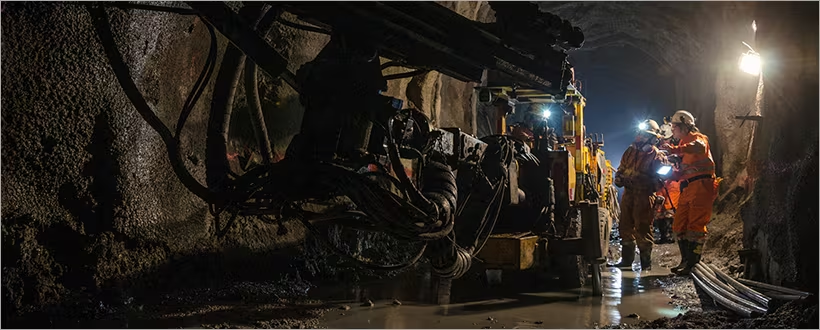
Rock movement, water, dust, and blast vibration test communications infrastructure in ways surface networks never experience.
Underground mining environments are dynamic and unforgiving. Ground movement crushes conduits, water ingress corrodes connections, and explosive charges generate shockwaves that disrupt sensitive electronics. Communications systems that appear adequate during commissioning often degrade unpredictably as mining advances and conditions change.
This degradation rarely presents as a complete outage. Instead, it manifests as reduced coverage zones, intermittent voice quality, delayed data, or tracking gaps that coincide with production blasts or geological activity. These symptoms are often mistaken for equipment failure when the root cause lies in the infrastructure's inability to withstand cumulative environmental stress.
Leaky feeder is a distributed antenna, not just a cable.
Leaky feeder coaxial cable remains the backbone for many underground voice and data networks, radiating and receiving signals through intentionally weak points in its shielding. Its effectiveness depends on precise installation, proper grounding, and consistent spacing. When installed as mere cable rather than as a tuned radiating system, coverage becomes patchy and unreliable.
Successful leaky feeder deployment requires understanding its frequency-dependent behaviour, coupling losses, and how mine geometry - including drifts, crosscuts, and stopes - affects signal propagation. It is a system, not a component, and must be engineered as such.

Mesh networks extend coverage dynamically but require disciplined channel planning to avoid self-interference during network growth.
Wireless mesh networks must be self-healing, not just self-forming.
Mesh networks adapt to changing topology as new nodes are added and paths shift with mining advance. However, self-forming behaviour without constraint can create unpredictable routing, latency spikes, and hidden single points of failure. Underground mesh requires controlled formation with defined primary paths and validated failover behaviour.
Radio planning underground is fundamentally different from surface deployment. Signal propagation is constrained by tunnel dimensions,拐弯, and metallised rock surfaces that cause multipath interference. Channel selection and power levels must account for these constraints to maintain stable links under varying load and environmental conditions.
Fibre provides bandwidth and electrical isolation, but its fragility demands protective design.
Fibre optic cabling is immune to electromagnetic interference from heavy equipment and high-voltage distribution, making it ideal for backbone connectivity between levels, shaft stations, and surface operations. However, underground fibre is vulnerable to crushing, shear forces from rock movement, and damage during development drilling and blasting.
Protective strategies include dedicated conduits with crush-resistant designs, strategic routing away from high-stress zones, and slack management to accommodate minor movement without exceeding bend radius limits. Fibre becomes a critical asset that, once damaged, can take days or weeks to repair, affecting all dependent systems.
Underground voice systems are lifelines, not conveniences.
VoIP over wireless or leaky feeder enables efficient coordination, but during emergencies, voice traffic must have guaranteed priority. Networks that treat voice as generic data risk congestion during incidents when multiple crews attempt simultaneous communication. Quality of Service (QoS) must be enforced at the infrastructure level, not assumed at the endpoint.
Push-to-Talk (PTT) over IP systems replicate traditional radio functionality while leveraging IP infrastructure. These systems require low latency and consistent packet delivery to feel natural to users. When latency varies or packets are lost, talk-around behaviour breaks down, reducing operational efficiency and safety confidence.
Tracking systems only work if the communications layer is deterministic.
Modern tracking uses RFID, Wi-Fi, or Bluetooth beacons to monitor personnel and equipment location. These systems generate constant background traffic that must be delivered reliably without interfering with critical voice or control data. When communications infrastructure becomes congested or unstable, tracking data develops gaps that compromise safety accounting and asset utilisation.
Tracking architectures should separate real-time location data from historical analytics, ensuring that safety-critical presence information is delivered immediately, while detailed movement patterns are stored for later analysis. This prevents essential safety functions from being delayed by non-urgent data processing.
Gas, airflow, and seismic data must flow even when other systems are stressed.
Environmental sensors monitor methane, carbon monoxide, oxygen levels, airflow velocity, and seismic activity. This data is critical for early warning and regulatory compliance. Communications networks must prioritise this telemetry, ensuring it reaches control rooms without delay, even during network maintenance or partial failures.
Sensor networks often use low-bandwidth, low-power protocols that are sensitive to latency and packet loss. Gateway placement, data aggregation points, and uplink redundancy determine whether environmental data remains reliable during evolving mine conditions. This infrastructure must be treated as safety-critical, not as auxiliary telemetry.
Communications must expand with mining advance without creating fragile dependencies or coverage gaps in active zones.
Networks must grow with the mine, not become obstacles to expansion.
As mining advances, communications infrastructure must extend into new areas without disrupting existing coverage. This requires planned expansion zones, pre-positioned backbone capacity, and clear procedures for integrating new wireless access points or leaky feeder runs. Ad-hoc expansion creates undocumented dependencies and uneven performance.
Resilience also means surviving partial infrastructure damage. Redundant paths, isolated power supplies, and segmented network zones ensure that a single cable cut or power loss does not silence entire sections of the mine. This design philosophy acknowledges that damage will occur and plans for graceful degradation rather than catastrophic failure.
Underground communications often rely on mine power, which is not always reliable.
Communications equipment typically draws power from the mine's electrical distribution system, which experiences voltage fluctuations, transient spikes, and occasional outages. Without proper conditioning and backup, these events cause network reboots, dropped connections, and data loss. Battery-backed UPS units at key aggregation points maintain continuity during brief interruptions.
In critical safety applications, such as emergency communications or environmental monitoring, standalone power with extended battery life may be necessary. This ensures that safety systems remain operational even when production power is intentionally shut down during emergencies or maintenance.
Heavy machinery generates electrical noise that disrupts unshielded communications.
Electric shovels, haul trucks, drill rigs, and conveyor drives produce broadband electromagnetic interference. Wireless networks operating in licence-free bands (2.4 GHz, 5 GHz) are particularly vulnerable. Strategic frequency selection, directional antennas, and physical separation from high-noise areas reduce this impact.
Wired systems are not immune. Improperly shielded copper cables can act as antennas, picking up noise that corrupts data. Fibre optic links provide inherent immunity but require careful grounding of transceivers to prevent ground loop issues that can damage equipment. The entire communications ecosystem must be designed with the mine's electrical environment in mind.
Throughput Technologies advises on underground communications architectures that withstand environmental stress, support safety systems, and enable efficient production.
Talk with a Solutions Specialist to review your underground communications infrastructure.
Physical damage from rock falls, water ingress at connectors, and cumulative vibration from nearby equipment gradually change the cable's electrical characteristics. Grounding points can corrode, and mechanical stress can alter the spacing of the radiating slots. Unlike surface coaxial systems, leaky feeder operates in a harsh, dynamic environment where maintenance access is limited, making proactive testing and planned replacement essential for sustained performance.
Yes, but only with careful design. Voice requires consistent low latency and minimal jitter. In a mesh network, each "hop" adds latency and potential variation. For reliable voice, the mesh should have a controlled depth (typically no more than 3-4 hops back to wired infrastructure), dedicated voice prioritisation (QoS), and sufficient backhaul capacity to handle peak call volume alongside data traffic. It should not be treated as a general-purpose data network with voice added as an afterthought.
Multiple strategies are used: routing cables in dedicated, blast-protected conduits away from the immediate blast perimeter; installing them in boreholes drilled specifically for communications; using armoured cable with robust jacketing; and leaving deliberate slack loops at regular intervals to absorb minor movement without exceeding the fibre's bend radius. The most critical factor is coordination with mine planning to ensure communication routes are known and protected during shot design.
Tracking gaps are often a network congestion or latency issue, not a coverage problem. When many tags attempt to report simultaneously - such as during shift change or muster - the communication channel can become overloaded, causing some data packets to be delayed or dropped. Additionally, if the backhaul from wireless access points to the central server is undersized or experiencing high latency, location updates queue up, creating apparent gaps in the tracking timeline. The solution involves proper capacity planning and traffic prioritisation.
Extending networks reactively without updating the core design. Adding a new leaky feeder branch or wireless access point to cover a new area often creates an unexpected load on existing amplifiers, switches, or backhaul links. This can degrade performance for the entire existing network. Effective expansion requires reviewing capacity end-to-end, not just at the edge, and ensuring that power, backhaul, and management systems can handle the incremental load without compromising existing services.
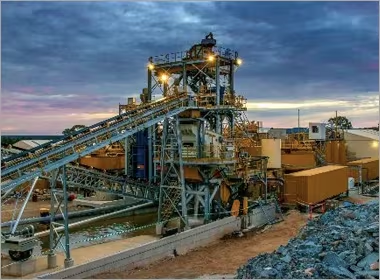
Designing industrial networks for crushers, conveyors, processing plants, and surface infrastructure that withstand dust, vibration, and continuous operation.
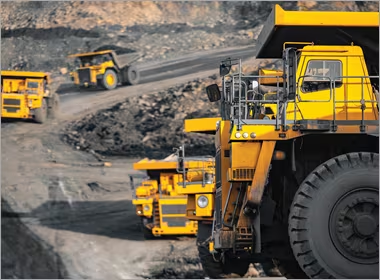
Enabling reliable communications for haul trucks, drills, shovels, and autonomous vehicles across pit operations and haul roads.

Protecting production and safety networks from cyber threats while ensuring operational continuity in remote and harsh mining environments.