
Transport Infrastructure Networks
Designing resilient networks for airports, ports, bridges, and tunnels that maintain operational control, safety systems, and service continuity through diverse challenges.
Power grid networks must deliver deterministic protection signalling, precise synchronization, and real-time control while integrating diverse generation sources, managing bidirectional power flows, and surviving electromagnetic disturbances that would disrupt ordinary communications.
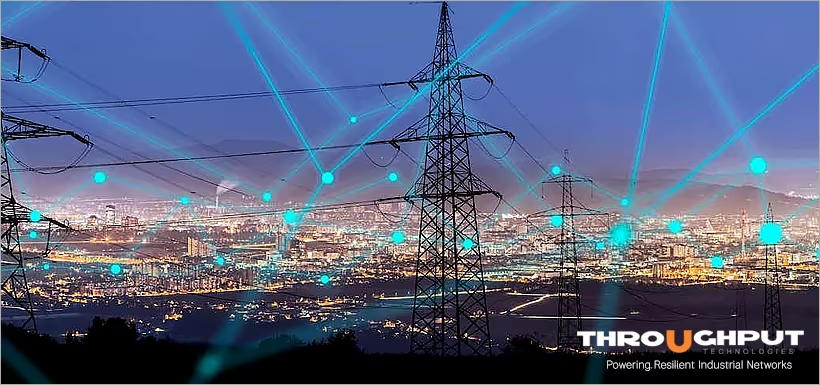
The electric grid operates at light speed; its communication networks must keep pace while maintaining absolute reliability.
Modern power systems are fundamentally communication-dependent. Protection relays must coordinate within milliseconds to isolate faults. Phasor Measurement Units (PMUs) require microsecond synchronization to detect grid instability. Renewable inverters need precise frequency and voltage control to maintain grid synchronism. Each of these functions depends on networks that provide deterministic latency, minimal jitter, and guaranteed delivery even during equipment failures or environmental stress.
Unlike enterprise networks where occasional packet loss is tolerable, power system communications must be virtually perfect. A delayed protection signal can cause cascading outages. Lost synchronization data can mask developing instability. Control message corruption can trigger unnecessary generation trips. The network is not merely carrying data; it is an integral component of the power system itself, subject to the same reliability requirements as circuit breakers and transformers.
Modern substations are communication hubs where network design directly influences protection speed and reliability.
IEC 61850 has transformed substation communications from point-to-point wiring to networked systems. Goose (Generic Object Oriented Substation Event) messages for protection and Sampled Values for instrumentation ride on Ethernet networks, requiring careful design to meet timing requirements. The network must guarantee delivery of critical messages within 4ms for protection and 3ms for sampled values, while handling less time-sensitive traffic like maintenance data.
Substation network architecture typically follows a hierarchical star or ring topology with strict segregation between process bus (instrument transformers, breakers), station bus (protection, control), and engineering/maintenance networks. Precision Time Protocol (PTP/IEEE 1588) provides microsecond synchronization across the substation. The design must also accommodate legacy protocols (DNP3, Modbus) during transition periods and provide cybersecurity measures that don't compromise timing requirements.

Substation networks must segregate protection, control, and maintenance traffic while meeting strict timing requirements for Goose and Sampled Values messaging.
Transmission networks span hundreds of kilometers, requiring diverse communication paths with coordinated protection and control.
High-voltage transmission lines carry both power and communications, with power line carrier (PLC) systems providing inherent communication paths. However, modern Wide Area Monitoring, Protection, and Control (WAMPAC) systems require higher bandwidth and lower latency than PLC can provide. Fiber optic cables along transmission rights-of-way (often integrated into ground wires - OPGW) form the backbone, supplemented by microwave and satellite links for redundancy.
Transmission communications must support multiple services: teleprotection (differential protection, distance protection), SCADA for grid operation, synchrophasor data for stability monitoring, and voice/data for maintenance crews. Each has different requirements - teleprotection needs ultra-low latency (< 10ms round trip), synchrophasors need precise time synchronization, while SCADA can tolerate higher latency. Network design must provide quality of service (QoS) to prioritize critical traffic across shared infrastructure.
Distribution networks are transforming from passive radial systems to active, managed grids with bidirectional power flow.
Smart grid initiatives add communication capabilities to distribution systems: smart meters, fault indicators, capacitor bank controllers, reclosers, and sectionalizers. These devices create a massive Internet of Things (IoT) deployment with unique challenges: thousands of endpoints spread across wide geographic areas, limited power for communications equipment, and heterogeneous technologies (RF mesh, cellular, PLC, fiber).
Distribution communications must support both real-time control (fault isolation, voltage regulation) and non-real-time data collection (meter reading, asset monitoring). The architecture typically uses a layered approach: field area networks (FAN) connecting devices to aggregation points, neighborhood area networks (NAN) aggregating multiple FANs, and wide area networks (WAN) connecting to utility control centers. Cybersecurity is particularly challenging given the large attack surface of distributed devices, many in publicly accessible locations.
Renewable sites combine generation, power conversion, and grid interconnection with demanding communication requirements.
Large solar farms and wind installations cover extensive areas with distributed generation assets. Inverters, trackers, combiner boxes, and weather stations must communicate with central controllers while withstanding harsh environmental conditions. Wind turbines add moving parts and tall structures that complicate wireless communications. Battery energy storage systems (BESS) require precise control to manage charge/discharge cycles and ensure safety.
Renewable site networks must handle both intra-site communications (between assets within the facility) and grid interconnection communications (with transmission or distribution operators). The former often uses industrial Ethernet or wireless mesh, while the latter typically uses fiber or licensed wireless with utility-grade reliability. As renewable penetration increases, these sites participate in grid services (frequency response, voltage support) requiring low-latency communication with grid operators.
Microgrids operate as independent grids but must seamlessly connect and disconnect from the main grid.
Microgrids combine local generation (solar, wind, generators), storage, and load management to operate independently during grid outages. Communications enable coordinated control of these diverse resources to maintain voltage and frequency stability. When reconnecting to the main grid, precise synchronization is required to prevent disturbances.
Microgrid communications face unique challenges: they must work during main grid outages (requiring local communication paths independent of utility infrastructure), support multiple ownership models (utility-owned, community-owned, commercial), and interface with utility systems using standard protocols (IEEE 2030.5, SunSpec Modbus). Network design must be resilient enough to maintain microgrid operation during extended islanding while secure enough to prevent unauthorized access when connected to the main grid.
Power system cybersecurity must protect critical functions without introducing unacceptable latency or single points of failure.
North American utilities follow NERC CIP standards, while other regions have similar frameworks. These mandate specific controls for critical cyber assets: access control, vulnerability management, incident response, and recovery plans. However, simply applying IT security practices can disrupt power operations. Firewalls must be configured to pass time-sensitive protocols without introducing jitter. Intrusion detection systems must understand industrial protocols to avoid false positives that could trigger unnecessary operational responses.
A defense-in-depth approach uses network segmentation to create security zones (control center, transmission, distribution, corporate) with controlled gateways. Unidirectional security gateways (data diodes) allow operational data to flow to corporate systems while preventing any traffic back into operational networks. Physical security is equally important - substation communications equipment must be in locked cabinets with tamper detection, while remote devices need protection against physical access.
Microgrid networks must maintain local communications during grid outages while providing secure interfaces for reconnection and energy market participation.
Power system communications operate in extreme electromagnetic environments that would disable ordinary networks.
Substations experience transient overvoltages from switching operations, fault currents, and lightning strikes. These create electromagnetic interference (EMI) that can induce voltages in communication cables, corrupting data or damaging equipment. Communications in high-voltage environments require specialized design: fiber optic cables for electrical isolation, properly grounded shielded cables for copper connections, surge protection at all interfaces, and physical separation from high-voltage equipment.
Equipment must meet specific EMC standards (IEC 61850-3 for substations, IEEE 1613 for communications devices). Testing includes immunity to fast transients, surges, electrostatic discharge, and radiated RF fields. In practice, this means selecting industrial-grade networking equipment specifically designed for power system environments, not repurposing commercial IT equipment.
Microsecond time synchronization enables grid visibility and control that was impossible a generation ago.
Phasor Measurement Units (PMUs) measure voltage and current phasors synchronized to UTC via GPS or Precision Time Protocol (PTP). These measurements reveal grid dynamics in real-time, enabling advanced stability control. Time synchronization must be maintained across vast geographic areas with sub-microsecond accuracy, requiring carefully designed timing networks with redundant sources and monitoring for anomalies.
Timing networks face multiple threats: GPS jamming or spoofing, network congestion affecting PTP messages, and equipment failures. Resilient designs use multiple timing sources (GPS, terrestrial radio, atomic clocks) with automatic failover. Timing monitoring systems detect anomalies and trigger alerts before synchronization degrades enough to affect grid operations. As grids become more dependent on synchronized measurements, timing infrastructure becomes as critical as the communication network itself.
Power infrastructure evolves over decades, requiring networks that bridge multiple technology generations.
A single utility may operate electromechanical relays from the 1960s, microprocessor-based relays from the 1990s, and IEC 61850 systems installed yesterday. Network architecture must support this heterogeneity during lengthy transition periods. Protocol converters translate between legacy serial protocols (DNP3, Modbus) and modern Ethernet-based systems. Network segmentation isolates legacy devices that cannot be secured to modern standards.
Modernization typically follows a phased approach, often starting with communications backbone installation, then gradually upgrading substations and control centers. The network must support parallel operation of old and new systems, with careful traffic engineering to prevent legacy system characteristics (like broadcast-heavy protocols) from affecting modern network performance. Each phase requires extensive testing to ensure that reliability is maintained or improved, never degraded.
Throughput Technologies advises on energy and power infrastructure network architectures that meet the dual demands of grid reliability and energy transition, from generation through transmission to distribution and customer interconnection.
Talk with a Solutions Specialist
to review your energy
infrastructure communication requirements.
Because power systems operate at 50/60 Hz, meaning events occur within 16.7-20 millisecond cycles. Protection relays must operate within 1-2 cycles (20-40ms) to prevent fault escalation. Differential protection compares currents at line ends simultaneously, requiring synchronization within microseconds. Phasor Measurement Units (PMUs) need 1-microsecond synchronization to calculate phase angles accurately for grid stability analysis. Inverter-based resources (solar, wind, storage) require precise timing for grid-forming and grid-following controls. Essentially, as power electronics replace rotating machines, timing precision becomes the new synchronizing mechanism for the entire grid.
Fundamentally. Hardwired systems use dedicated copper wires for each signal (one wire per trip command, per status indication). IEC 61850 replaces these with networked communications where multiple devices share Ethernet infrastructure. This requires careful network design to ensure timing requirements are met: VLANs to separate traffic classes, quality of service (QoS) to prioritize protection messages, redundant network paths (PRP/HSR) for availability, and precise timing distribution (PTP). The network becomes part of the protection system and must be designed, tested, and maintained as such - it's no longer "just communications."
Three primary challenges: scale, environment, and grid integration. Solar farms can cover square kilometers with thousands of devices needing connectivity. Wind farms have moving turbines complicating wired connections. Both face harsh environments (heat, cold, UV, salt, sand). Grid integration requires low-latency communication for grid services (frequency response, voltage support) and fault ride-through coordination. Solutions often combine technologies: fiber backbone with wireless last-mile to individual devices, industrial Ethernet switches in weatherproof enclosures, and redundant communication paths to grid operators. Cybersecurity is also critical as these sites become targets.
Microgrids must operate in both grid-connected and islanded modes, requiring communications that work without utility infrastructure. They integrate diverse resources (generators, solar, storage, loads) that may have different owners and communication protocols. During islanding, the microgrid must maintain internal synchronization and control without external timing references. When reconnecting, precise synchronization with the main grid is needed. Microgrid communications are typically more localized (within a campus or community) but must support complex control algorithms for economic dispatch, black start, and seamless transition between operating modes. They also need secure interfaces to utility systems for energy market participation.
Through risk-based segmentation and security controls designed for OT environments. Critical cyber assets are identified and protected with appropriate controls. Network segmentation creates security zones with controlled gateways. Firewalls are configured to pass industrial protocols without adding unacceptable latency. Unidirectional gateways allow data extraction without inbound access. Patch management is scheduled during maintenance windows, with compensating controls for vulnerabilities that can't be immediately patched. The key is understanding that availability is paramount in power systems - security controls must not create single points of failure or disrupt time-sensitive operations. This requires collaboration between cybersecurity experts and power system engineers.

Designing resilient networks for airports, ports, bridges, and tunnels that maintain operational control, safety systems, and service continuity through diverse challenges.
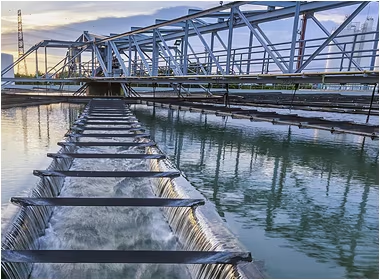
Network design for water treatment, distribution, wastewater management, and environmental monitoring systems that protect public health and ecosystem integrity.

Protecting critical infrastructure networks from cyber threats while ensuring operational continuity through defense-in-depth architectures and resilient design principles.