
Transport Infrastructure Networks
Designing resilient networks for airports, ports, bridges, and tunnels that maintain operational control, safety systems, and service continuity through diverse challenges.
Critical infrastructure cybersecurity must protect operational continuity above all else, implementing defense-in-depth that contains threats without creating single points of failure, while network resilience ensures services continue through cyber attacks, equipment failures, and environmental stress.
In critical infrastructure, security failures become safety incidents, and network failures become service outages affecting entire communities.
Transport systems, energy grids, water networks, and public safety communications form society's operational backbone. Their protection cannot follow conventional IT security models that prioritize confidentiality over availability or introduce points of failure for inspection. Instead, critical infrastructure requires a balanced approach where security enhances rather than compromises resilience, where threats are contained without disrupting essential functions, and where systems degrade gracefully rather than failing catastrophically.
This balance is particularly challenging because critical infrastructure combines legacy systems with decades-long lifecycles, modern digital controls, increasing connectivity, and evolving threat landscapes. Attack surfaces expand as operational technology (OT) networks interconnect with IT systems and external partners. Meanwhile, resilience must address not only cyber threats but also physical attacks, natural disasters, equipment failures, and human error - all while maintaining 24/7 service delivery.
Layered security must protect without creating choke points that become single points of failure.
Traditional defense-in-depth stacks security controls at network boundaries, creating inspection points that can become bottlenecks or failure points. For critical infrastructure, defense-in-depth must be distributed throughout the architecture. This means segmenting networks into security zones with controlled gateways, implementing security controls at multiple layers (network, host, application), and ensuring that no single security device failure compromises overall protection.
Critical systems should operate in isolated zones with strictly controlled communication paths. Less critical support systems occupy separate zones with appropriate protections. Industrial Demilitarized Zones (IDMZ) provide controlled interfaces between OT and IT networks. The key is designing zones so that a compromise in one area (like corporate IT) cannot directly propagate to critical control systems, while still allowing necessary data exchange for operations and maintenance.

Secure remote access must provide controlled, audited connectivity for support teams without placing external entities on operational networks.
Critical infrastructure requires external support, but traditional VPNs create unacceptable risk exposure.
Equipment manufacturers, specialized technicians, and remote operations centers require access to critical systems for maintenance, diagnostics, and support. Standard VPN solutions grant broad network access, creating potential entry points for threats. Modern approaches use zero-trust principles: users and devices are never inherently trusted, access is granted only to specific resources for limited durations, and all sessions are monitored and recorded.
For critical infrastructure, secure remote access should broker connections rather than placing external users on the network. The support technician sees only the specific HMI or diagnostic tool they need, with no ability to move laterally to other systems. Multi-factor authentication, session recording, and automatic timeout after inactivity provide additional safeguards. Access policies should be role-based and time-limited, with emergency access procedures that maintain security even during crisis response.
OT networks have predictable traffic patterns - deviations indicate potential compromise long before traditional indicators appear.
Unlike enterprise IT with highly variable traffic, critical infrastructure operational networks are deterministic. PLCs poll sensors at fixed intervals, control loops execute on predictable schedules, and communication follows established patterns. Industrial intrusion detection systems (IDS) can establish this baseline of normal behavior and alert on anomalies: new connections to unusual destinations, traffic at unexpected times, protocol violations, or communication patterns that deviate from established norms.
Effective OT intrusion detection requires understanding industrial protocols and control system behavior. It must distinguish between legitimate operational changes (a pump starting, a valve opening) and potentially malicious activity. Because many OT devices cannot host endpoint protection, network-based detection becomes the primary layer for identifying compromises. Integration with Security Information and Event Management (SIEM) systems provides correlated visibility across IT and OT environments, though careful filtering is needed to avoid alert overload from normal OT operations.
Regulatory frameworks provide structured approaches but must be adapted to operational realities.
Critical infrastructure sectors follow various regulatory frameworks: NERC CIP for electric utilities, TSA directives for transportation, Water Sector-specific plans, and international standards like IEC 62443. These frameworks mandate specific security controls but often require interpretation for individual implementations. Compliance should be viewed as a minimum baseline, not a comprehensive security program.
Effective compliance starts with asset identification and classification - understanding which systems are truly critical to operations and safety. Risk assessments determine appropriate protection levels. Documentation provides evidence of compliance but also serves operational purposes, creating clear understanding of system architecture, communication paths, and security boundaries. Regular audits and exercises validate that security controls work as intended during both normal operations and emergency conditions.
When incidents occur, response must prioritize safety and continuity over investigation and attribution.
Critical infrastructure incident response differs fundamentally from IT incident response. The primary goals are: ensure personnel and public safety, maintain essential services, contain the threat, restore normal operations, and only then conduct forensic investigation. This operational prioritization means that some evidence may be lost or contaminated, but service continuity is preserved.
Response plans should include clear decision authorities, communication protocols (including when to involve law enforcement and regulators), and technical playbooks for common scenarios. Isolated backup control capabilities - perhaps manual control panels, segregated backup systems, or fail-safe modes - provide resilience if primary control networks are compromised. Regular tabletop exercises involving operations, safety, security, and management teams build muscle memory for coordinated response under pressure.
Critical infrastructure has long lifecycles with components from global suppliers, creating embedded risk that accumulates over decades.
A single substation, treatment plant, or control system contains components from dozens of suppliers worldwide, many with their own sub-suppliers. Vulnerabilities or malicious code can be introduced at any point in this chain and persist for the asset's lifetime. Supply chain security requires vetting suppliers, verifying software/firmware integrity, and maintaining inventories of installed components with their security status.
For critical systems, consider: requiring suppliers to provide software bills of materials (SBOM), verifying cryptographic checksums before installation, conducting security assessments of supplier development practices, and isolating third-party maintenance networks. This is particularly important for safety systems where compromise could have immediate physical consequences. Asset owners should maintain the capability to update or replace compromised components even if the original supplier is unavailable.
Critical operations require geographically separate control centers with independent communication paths to survive localized incidents affecting primary infrastructure.
Single points of failure in network design create both availability and security vulnerabilities.
Networks with central choke points for security inspection create availability risks - if the central firewall fails, all communication stops. They also create security risks - attackers who compromise the central device gain control over all traffic. Resilient designs use distributed security controls with redundant paths. For critical operations, consider geographically separate control centers with independent network infrastructure, ensuring that an incident at one location (fire, flood, physical attack) doesn't disable entire operations.
Diversity extends beyond geography: diverse communication technologies (fiber, licensed wireless, satellite), diverse power sources (grid, generator, UPS), and diverse routing paths avoid common failure modes. The goal is defense-in-breadth where capabilities are distributed rather than centralized, and failures degrade gracefully rather than catastrophically. This approach acknowledges that some failures will occur and plans for continued operation despite them.
Network equipment in publicly accessible or remote locations requires physical protection equal to its cyber protection.
Critical infrastructure networks extend far beyond secure control rooms: field devices in substations, sensors along pipelines, communication cabinets beside highways, wireless equipment on towers. These distributed assets face physical threats: vandalism, theft, accidental damage, or intentional tampering. Physical security must be commensurate with the consequence of compromise.
Protection strategies include: tamper-evident enclosures with intrusion detection, equipment located in secure buildings or fenced compounds, surveillance cameras monitoring critical locations, and regular physical inspections. Remote sites may need cellular or satellite-based alarm systems that alert to physical intrusions. For particularly critical locations, consider redundant equipment with diverse physical locations so that compromise of one site doesn't disable the function. Physical and cyber security must be integrated - a physically compromised device becomes a cyber vulnerability.
Vast distributed infrastructure requires centralized visibility with local autonomy for critical functions.
Critical infrastructure spans cities, regions, or entire countries with assets in remote locations. Network and security management must provide centralized visibility and control while allowing local sites to operate independently during communication outages. This typically involves hierarchical management: local controllers handle time-sensitive functions, regional centers provide oversight, and national centers offer strategic visibility.
Bandwidth constraints at remote sites influence security architecture. Continuous monitoring data may need local aggregation with only exception reporting transmitted centrally. Security alerts should be prioritized so critical incidents receive immediate attention while lower-priority notifications are queued. The management system itself must be secure, with encrypted communications, strict access controls, and its own resilience measures. Perhaps most importantly, management interfaces should be designed for use during crisis conditions when operators are stressed and time is critical.
Throughput Technologies advises on cybersecurity and network resilience architectures for critical infrastructure that implement defense-in-depth without creating single points of failure, ensuring operational continuity through cyber and physical threats.
Talk with a Solutions Specialist to conduct a cybersecurity and resilience assessment of your critical infrastructure.
Standard IT security prioritizes confidentiality and often sacrifices availability for security. In critical infrastructure, availability is paramount - security must enhance, not compromise, continuous operation. IT security tools often can't withstand harsh environments, may block or delay industrial protocols they don't understand, lack deterministic performance needed for control systems, and require frequent updates/reboots that disrupt 24/7 operations. IT incident response focuses on investigation and evidence preservation; critical infrastructure incident response prioritizes safety and service continuity, potentially sacrificing forensic data. The mindset, tools, and priorities are fundamentally different.
Through controlled interfaces rather than open connections. Industrial DMZ (Demilitarized Zone) architectures provide secure data exchange between OT and IT networks using broker services, not direct connections. Unidirectional gateways allow operational data to flow to business systems while preventing any traffic back into operational networks. For bidirectional needs, properly configured firewalls with deep packet inspection for industrial protocols enable necessary communication while blocking threats. The key is identifying exactly what data needs to flow where, for what purpose, and implementing the minimal necessary pathways with maximum monitoring. Regular reviews ensure these pathways remain necessary and secure as operations evolve.
Network segmentation. Most legacy critical infrastructure evolved with flat networks where everything connects to everything. Segmenting these networks into security zones with controlled gateways immediately contains threats and makes all subsequent security measures more effective. Start by identifying critical systems (safety, core operations) and isolating them. Create separate zones for support systems, corporate IT interfaces, and third-party access. Even basic segmentation using VLANs with access control lists provides immediate risk reduction. This approach doesn't require replacing legacy equipment, works incrementally, and provides visible security improvement that builds support for more comprehensive measures. It's the foundation upon which other security controls can be built.
Through diversity, autonomy, and graceful degradation. Diverse communication paths (different technologies, providers, physical routes) prevent single points of failure. Local autonomy ensures sites can operate independently if central coordination is compromised. Systems should be designed to degrade gracefully - losing some capabilities but maintaining critical functions. Geographic separation of control centers with independent infrastructure prevents regional incidents from causing system-wide failure. Regular exercises simulating multi-site attacks test these capabilities. Perhaps most importantly, maintain manual backup procedures for truly critical functions - when digital systems fail, well-trained personnel following clear procedures can maintain essential services. Resilience is about options and adaptability, not just redundancy.
Continuously and at multiple frequencies. Continuous monitoring watches for anomalies in network traffic, system behavior, and physical access. Vulnerability scans should occur monthly or after significant changes. Penetration testing by qualified professionals should be annual at minimum, or after major system changes. Tabletop exercises involving operations, security, and management should be quarterly for core teams, with full-scale exercises annually. The most valuable testing often occurs during actual incidents or near-misses - thorough after-action reviews identify improvements. Remember that testing shouldn't disrupt operations; schedule intrusive tests during maintenance windows, use isolated test environments where possible, and always have rollback plans. The goal is building confidence, not causing outages.
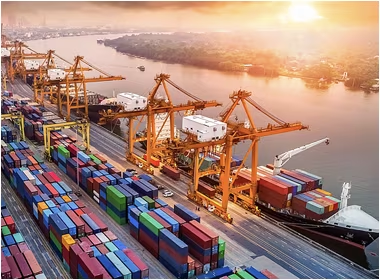
Designing resilient networks for airports, ports, bridges, and tunnels that maintain operational control, safety systems, and service continuity through diverse challenges.
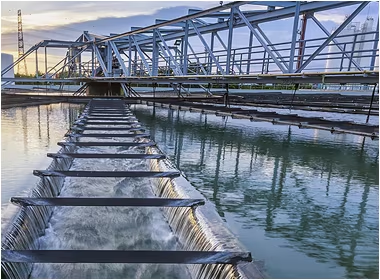
Network design for water treatment, distribution, wastewater management, and environmental monitoring systems that protect public health and ecosystem integrity.
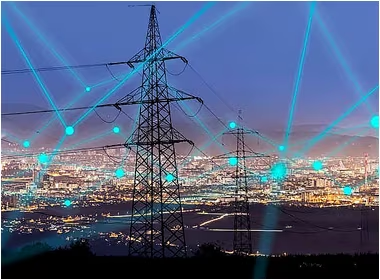
Designing resilient networks for power generation, transmission, distribution, and renewable energy infrastructure that ensure grid stability and operational continuity.