
Smart City Network Backbone Architecture
Designing resilient municipal fibre and wireless backbone infrastructure for public services, IoT connectivity, and future smart city applications with appropriate redundancy and segmentation.
Municipal control centres integrate traffic management, public safety dispatch, emergency coordination, and service monitoring – requiring networks that balance information sharing between functions with security isolation between systems, all while maintaining continuous operation during crises when demand peaks.
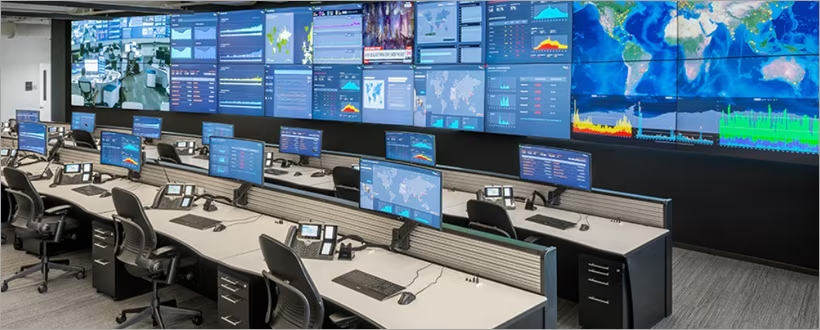
Control centre networks designed for normal operations often collapse under the combined load of multiple emergency services during major incidents – when video feeds multiply, radio traffic peaks, and data systems experience simultaneous query surges from all responding agencies.
During routine operations, traffic management, public safety, and utility monitoring systems operate relatively independently. During major incidents – severe weather, transportation accidents, public events, or security threats – these systems must coordinate while each experiences peak demand. Traffic management diverts vehicles around incidents while emergency services access the scene; public safety coordinates multiple agencies; utilities monitor for secondary impacts. The network interconnecting these systems becomes the coordination mechanism, and if undersized or poorly designed, it becomes the bottleneck precisely when seamless integration is most critical.
Effective control centre network design starts with understanding peak simultaneous loads: not just average bandwidth but worst-case scenarios where all systems operate at maximum capacity concurrently. Network capacity must accommodate these peaks with headroom for growth. More importantly, the network must prioritise critical communications during congestion – emergency video feeds over routine monitoring, incident coordination over administrative traffic. Quality of service (QoS) mechanisms alone are insufficient; the architecture itself must provide dedicated resources for critical functions while allowing efficient resource sharing during normal operations.

Traffic management networks integrate video surveillance, signal control, variable message signs, and incident detection systems with low-latency requirements for real-time response.
Traffic Management Centres (TMCs) require deterministic networks that deliver real-time video, signal control data, and incident alerts with minimal latency while integrating with public safety and transportation systems.
Modern TMCs receive hundreds of video feeds from cameras monitoring intersections, motorways, tunnels, and bridges. Each high-definition stream requires 4–8 Mbps, totalling multiple gigabits of continuous video traffic. Simultaneously, traffic signal controllers exchange timing data with sub-second latency requirements, variable message signs receive updates, and incident detection systems generate alerts. The network must deliver this diverse traffic with appropriate priorities – video for incident verification gets higher priority than routine monitoring feeds.
TMC network architecture typically uses a multi-tier design: edge switches at camera and sensor locations, aggregation switches in field cabinets, and core switches in the control centre. Fibre optic connections provide the bandwidth and distance capabilities for city-wide deployments. Virtual Local Area Networks (VLANs) segment different traffic types: video, signal control, management. Precision Time Protocol (PTP – IEEE 1588) synchronises cameras and timestamped incidents across the network. Integration with public safety networks requires secure gateways that allow information sharing while maintaining separation – for example, sharing camera feeds with emergency responders without granting direct network access.
Public safety answering points (PSAPs) and emergency operations centres (EOCs) require ultra-reliable networks with diverse redundancy, secure isolation, and guaranteed performance for life-critical communications.
Emergency call handling, dispatch systems, and field communications form the core of public safety networks. Next-generation 911 (NG911) systems add multimedia capabilities – text, images, video from citizens – increasing bandwidth requirements. Computer-aided dispatch (CAD) systems integrate with geographic information systems (GIS), vehicle location tracking, and records management. Radio systems – both traditional land mobile radio (LMR) and emerging broadband systems – interface with the network for console connectivity and recording.
Public safety networks implement the highest levels of redundancy: diverse fibre entry routes into facilities, redundant network equipment with hot standby, uninterruptible power supplies (UPS) with generator backup, and geographically separate backup centres. Security isolation is paramount – these networks typically operate completely separately from general municipal networks, with controlled gateways for necessary information exchange. Network performance guarantees include maximum latency for dispatch data and prioritisation of emergency traffic over all other communications. Equipment from partners like Westermo provides the reliability and environmental hardening needed for 24/7 operations.
During major incidents, multiple agencies must coordinate through shared situational awareness – requiring networks that securely integrate disparate systems while maintaining each agency's operational independence and security postures.
Fire, police, emergency medical services, transportation, utilities, and other agencies each have their own communications systems and protocols. Effective coordination requires sharing specific information – incident location, resource status, road closures, hazard information – without merging entire networks. Integrated emergency coordination networks provide this through controlled data exchange: common operating picture systems that aggregate information from multiple sources, secure video sharing portals, and interoperable communications gateways.
The network architecture for emergency coordination typically uses an information exchange gateway model rather than full network integration. Each agency connects to a secure exchange platform through controlled interfaces – firewalls with specific rules about what data can pass in which direction. Role-based access controls determine which personnel can see which information. During non-emergency periods, these connections may carry only minimal heartbeat traffic; during incidents, bandwidth automatically increases based on incident severity. The key design principle is "need to share" rather than "nice to share" – balancing information accessibility with security requirements.
Water, electricity, and gas utility monitoring requires deterministic networks for SCADA systems while enabling secure data sharing with municipal operations centres.
Utility Supervisory Control and Data Acquisition (SCADA) systems monitor and control critical infrastructure, requiring deterministic networks with guaranteed response times that integrate with municipal operations for coordinated incident response.
Water treatment plants, pumping stations, electrical substations, and gas distribution networks operate with SCADA systems that have specific network requirements: cyclic data exchange with predictable timing, maximum latency guarantees for control commands, and high availability (typically 99.99% or better). These systems traditionally used dedicated networks, but modern approaches integrate them with municipal operations for better coordination – water utilities knowing about major fires, electricity providers aware of traffic signal outages.
Integration occurs at multiple levels: data level (sharing status information), visualisation level (displaying utility information in municipal operations centres), and control level (coordinated responses during emergencies). The network architecture must maintain the deterministic characteristics required by SCADA while enabling this integration. Typically, utility networks remain operationally separate with data diodes or unidirectional gateways sending information to municipal systems. During emergencies, controlled bidirectional communication may be enabled for coordination. Time synchronisation across all systems ensures event correlation – knowing exactly when a power outage occurred relative to traffic signal failures.
Large-format video walls displaying maps, camera feeds, data visualisations, and status dashboards require high-bandwidth, low-latency networks that deliver multiple video streams simultaneously without frame drops or synchronisation issues.
Modern control centres use video walls comprising dozens of displays showing hundreds of information sources. Each source – camera feed, GIS map, data dashboard, alert panel – requires network delivery to display processors. Display processors then composite these sources into the video wall layout. The network between sources and processors must handle multiple high-resolution streams with precise timing to avoid visual artifacts like tearing or stuttering.
Video wall networks typically use 10 GbE or higher backbone connections with quality of service (QoS) ensuring video traffic receives priority. Multicast networking efficiently delivers the same stream to multiple display processors. Frame synchronisation protocols align video timing across displays. For camera feeds, edge processing can reduce bandwidth by extracting regions of interest rather than transmitting full frames. The network design must also accommodate control traffic – operators changing layouts, selecting sources, adjusting parameters – with minimal latency to ensure responsive interaction. Integration with audio systems for voice alerts and intercom adds another layer of network requirements.
Municipal control centres require geographic redundancy – secondary sites that can assume operations during primary site outages – with networks that enable seamless failover without data loss or service interruption.
Primary control centres face various risks: localised disasters (fire, flood), infrastructure failures (power, fibre cuts), security incidents, or planned maintenance. Geographic redundancy provides continuity through secondary sites located sufficiently distant to avoid common failure modes but close enough for staff access. The network connecting primary and secondary sites enables data replication, session synchronisation, and failover coordination.
Active-active designs distribute load between sites during normal operations, while active-standby maintains a ready backup. Data replication occurs over dedicated fibre or encrypted tunnels across diverse paths. Session synchronisation ensures operator consoles can fail over with minimal disruption. The failover process itself must be tested regularly – untested redundancy often fails when needed. Network considerations include bandwidth for replication traffic, latency limits for real-time systems, and security for inter-site communications. For the highest criticality systems, tertiary sites or mobile command centres provide additional resilience layers. Partners like Secomea provide secure remote access solutions that enable distributed operations during centre outages.
Throughput Technologies advises on municipal control centre network architecture that integrates disparate systems while maintaining security isolation, providing deterministic performance for critical functions, and ensuring continuous operation through redundancy and disaster recovery planning.
Talk with a Solutions Specialist to design your municipal control centre network infrastructure.
Modern video walls with 4K sources require significant bandwidth. A single 4K stream at 30 frames per second with H.264 compression needs 15–25 Mbps; at 60 fps, 25–40 Mbps. A wall displaying 20 simultaneous sources therefore needs 300–800 Mbps continuous bandwidth, plus overhead for control traffic. Using H.265 compression reduces this by 30–50%. More importantly, the network must handle burst traffic when operators switch sources or layouts. Dedicated video networks with 10 GbE core links are now standard for major control centres. Edge processing – decoding at source and transmitting only pixels needed for display – can further reduce bandwidth by 60–80% for camera feeds showing only specific regions of interest.
Implement a data classification and sharing framework. Classify information by sensitivity: public, internal, restricted, confidential. Define what each agency needs from others for each incident type – fire response needs building plans from municipal records, traffic information from transportation, utility shutoff locations from providers. Implement controlled gateways rather than network merging: each agency connects to a secure exchange platform with specific data sharing rules. Use attribute-based access control (ABAC) – decisions based on user role, incident type, data classification, and need-to-know. Audit all data exchanges. During non-emergency periods, test sharing with simulated incidents. The goal is enabling necessary coordination while maintaining each agency's security posture.
It depends on the failover design and what's considered "operational." Hot standby with real-time replication can achieve 30–60 seconds for critical systems to be available at the backup site, though full operational capability may take 5–15 minutes as operators relocate and establish communications. Warm standby might take 5–30 minutes for critical systems. The network plays a crucial role: sufficient bandwidth for real-time replication, low latency for session synchronisation, and automated failover mechanisms. Regular testing is essential – untested failover often takes hours rather than minutes. Document recovery time objectives (RTO) for each system: dispatch systems might need 60 seconds, while historical reporting can take hours. Design to meet the most stringent RTO while accepting longer times for less critical functions.
Use protocol gateways and encapsulation. Legacy systems using serial protocols (RS-232, RS-485) or older network protocols can be connected via serial-to-Ethernet converters – devices like those from ProSoft Technology or Westermo that provide robust conversion with protocol preservation. For legacy video systems, use encoders that convert analogue feeds to IP. Create separate network segments for legacy systems with controlled gateways to modern networks. Where possible, virtualise legacy applications to run on modern hardware while preserving their original interfaces. Plan migration paths: legacy systems should be replaced or upgraded according to a schedule, with the network design accommodating both old and new during transition periods. Document all integration points thoroughly – legacy system interfaces often lack documentation.
Implement multi-layer monitoring: infrastructure (switch ports, router interfaces, link status), performance (bandwidth utilisation, latency, packet loss), application (service availability, response times), and security (intrusion detection, anomalous traffic). Set thresholds based on normal operation baselines – alert when utilisation exceeds 70% during peak hours, or latency increases beyond application requirements. Correlate network events with control centre operations – if video feeds drop simultaneously with network interface errors, the cause is likely network rather than cameras. Integrate monitoring with ticketing systems to automate incident creation. Most importantly, monitor from the user perspective – synthetic transactions that simulate operator actions verify end-to-end functionality. Regular reporting identifies trends before they become problems.
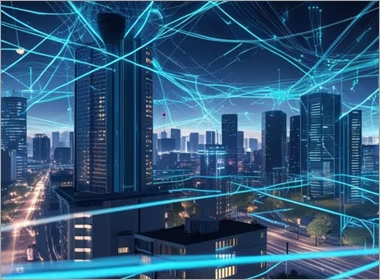
Designing resilient municipal fibre and wireless backbone infrastructure for public services, IoT connectivity, and future smart city applications with appropriate redundancy and segmentation.
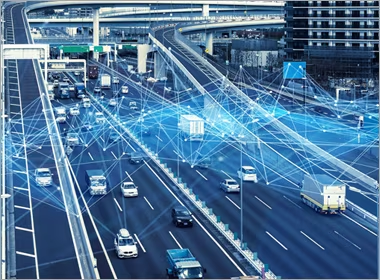
Designing local networks for IoT sensors, edge computing nodes, and last-mile connectivity that integrate with municipal backbones while surviving harsh urban environments.

Protecting municipal networks from cyber threats while ensuring operational continuity through segmentation, secure access, intrusion detection, and resilient design for critical urban infrastructure.