
Smart City Network Backbone Architecture
Designing resilient municipal fibre and wireless backbone infrastructure for public services, IoT connectivity, and future smart city applications with appropriate redundancy and segmentation.
Municipal networks must protect critical infrastructure from cyber threats while maintaining 24/7 service availability – a balance requiring security measures that defend without disrupting essential public services, and resilience strategies that ensure continuity during both technical failures and malicious attacks.

Traditional cybersecurity approaches prioritise confidentiality and integrity, often at the expense of availability – a trade-off that municipal services cannot afford when public safety, transportation, and utilities depend on continuous network operation.
Smart city networks connect disparate systems with different risk profiles: traffic signals requiring 99.99% availability, public Wi-Fi accepting occasional downtime, emergency communications needing absolute reliability during crises. Security measures that interrupt service for patching, reboot systems after detecting anomalies, or block traffic during suspected attacks can have cascading effects on urban life. The challenge is implementing security that protects without disrupting – segmentation that contains threats without breaking legitimate communications, monitoring that detects attacks without false positives that halt essential services, and access controls that prevent unauthorised entry without impeding emergency response.
Effective municipal cybersecurity starts with risk assessment specific to urban operations: which systems could cause physical harm if compromised (traffic control, water treatment), which could enable criminal activity (surveillance camera access), and which would cause significant public disruption (transportation systems). Security controls are then prioritised based on these risks, with acceptance that not all systems can achieve the same security level – critical infrastructure receives the highest protection, while less critical systems may accept higher risk in exchange for functionality or cost savings.

Segmentation separates operational technology networks from enterprise systems, containing threats while enabling necessary data exchange through controlled gateways.
Operational technology (OT) networks controlling physical infrastructure require separation from information technology (IT) networks, with controlled data exchange points that prevent threat propagation while enabling operational coordination.
Municipal OT includes traffic signal controllers, water SCADA (Supervisory Control and Data Acquisition) systems, building management systems, and public safety communications. These systems often run on legacy platforms with limited security capabilities and cannot tolerate the disruption of typical IT security measures. Network segmentation creates security zones: OT networks for control systems, IT networks for administrative functions, and demilitarised zones (DMZs) for data exchange between them.
Implementation uses firewalls with deep packet inspection for industrial protocols, not just port-based blocking. Data diodes or unidirectional gateways allow OT data to flow to IT systems for monitoring and analysis while preventing any return traffic that could carry threats. The segmentation must accommodate legitimate operational needs – emergency services may need temporary access to traffic cameras during incidents, maintenance teams require remote access to equipment. These exceptions are managed through just-in-time access with approval workflows and session monitoring. Partners like Secomea provide secure remote access solutions that enable necessary connectivity without compromising segmentation principles.
Third-party vendors, maintenance personnel, and emergency responders require secure remote access to municipal systems without creating persistent vulnerabilities or compromising network segmentation.
Traditional virtual private network (VPN) solutions grant broad network access once authenticated, creating risk if credentials are compromised or devices are infected. Zero-trust remote access applies the principle of least privilege: each connection is authenticated, authorised, and encrypted for specific systems only, with continuous verification throughout the session. Access is granted based on multiple factors: user identity, device health, requested resource, time of day, and operational context.
Implementation considerations for municipalities include integration with existing identity management systems, support for various user types (employees, contractors, emergency responders), and operational requirements during incidents when access needs may change rapidly. Session recording provides audit trails for compliance and incident investigation. Time-limited access that expires automatically reduces the risk of forgotten active sessions. For critical systems, requiring local operator approval for each remote connection adds a human verification layer. The network must accommodate these security gateways without creating single points of failure – redundant access systems ensure maintenance and emergency response capabilities remain available.
Industrial intrusion detection systems (IDS) monitor municipal network traffic for malicious activity, recognising anomalies in operational protocols rather than just traditional IT attack patterns.
Smart city networks use protocols like Modbus, DNP3, PROFINET, and IEC 61850 for control systems, alongside IT protocols for administrative functions. An industrial IDS understands these operational protocols enough to detect anomalies: unexpected function codes in traffic signal communications, abnormal timing in water SCADA communications, or unauthorised configuration changes to building management systems. It establishes baselines of normal traffic during commissioning and alerts on deviations.
Placement of IDS sensors is critical: at zone boundaries to monitor cross-segment traffic, within OT networks to detect lateral movement, and at remote access entry points. Sensors must be passive (not inline) to avoid affecting network performance or creating single points of failure. Integration with security information and event management (SIEM) systems consolidates alerts, but municipal operations often require dedicated OT security monitoring with personnel who understand both network security and urban operations. Response procedures must balance security with operational continuity – automatically blocking traffic during suspected attacks could disrupt essential services, so human review may be necessary before taking action.
Municipal cybersecurity must comply with multiple standards including IEC 62443, NIST frameworks, and local regulations while addressing unique urban operational requirements.
Municipal cybersecurity programmes must satisfy multiple compliance requirements: international standards, national regulations, sector-specific guidelines, and local policies – often with overlapping but not identical requirements.
Relevant standards include IEC 62443 for industrial automation and control systems, NIST (National Institute of Standards and Technology) frameworks for critical infrastructure, ISO 27001 for information security management, and local regulations specific to municipal operations. Each standard has its own focus: IEC 62443 emphasises zone-and-conduit segmentation for OT, NIST provides risk management frameworks, ISO 27001 covers comprehensive security management systems. Municipalities often need to satisfy multiple frameworks simultaneously.
Effective compliance starts with mapping requirements across standards to identify overlaps and gaps. Control implementation then addresses the most stringent requirements where they overlap, with additional controls for unique requirements. Documentation is critical – evidence of compliance for auditors and regulators. Regular assessments validate that controls remain effective as networks evolve. Importantly, compliance should enable rather than constrain security – the goal is protecting municipal operations, not merely checking boxes. Security programmes should exceed minimum compliance requirements for critical systems, recognising that standards represent minimum baselines rather than optimal security.
Cybersecurity incidents affecting municipal infrastructure require response procedures that balance containment with continuity – isolating threats without disrupting essential public services.
When a cyber incident affects traffic systems, water treatment, or public safety communications, the response must consider operational impacts alongside security concerns. Standard incident response procedures often recommend immediate isolation of affected systems, but for municipal infrastructure, this could mean disabling traffic signals during rush hour or shutting down water treatment. Response plans need graduated options: initial containment that limits damage while maintaining partial functionality, with escalation to full isolation only when absolutely necessary.
Incident response planning involves multiple municipal departments: IT, operational teams, public communications, legal, and executive leadership. Tabletop exercises simulate various scenarios: ransomware affecting building management systems, denial-of-service attacks on emergency communications, unauthorised access to surveillance cameras. Response procedures document decision criteria: when to involve law enforcement, when to issue public notifications, when to activate backup systems. Communication plans ensure coordinated messaging to the public during incidents that affect services. Post-incident reviews identify improvements to both security controls and response procedures.
Network resilience for smart cities requires geographic diversity – redundant systems at separate locations with diverse connectivity paths that survive localised disasters, infrastructure failures, or targeted attacks.
Single points of failure in municipal networks can cascade across multiple services: a fibre cut disabling both traffic signals and emergency communications, a power outage affecting water treatment and public safety centres. Resilience design identifies these interdependencies and implements diversity: separate fibre routes entering facilities from different directions, backup control centres in different geographic areas, redundant network cores with automatic failover.
Geographic diversity considerations include distance – far enough to avoid common failure modes (flood zones, power grids) but close enough for staff access and low-latency communications. Path diversity uses different technologies: fibre primary with wireless or cellular backup. Testing failover regularly validates that redundancy works as intended – untested redundancy often fails when needed. For the highest criticality systems, consider tertiary redundancy or mobile command centres. Resilience extends beyond technology to processes and people – backup operators trained at alternative locations, documented procedures for degraded operations, and supply chain diversity for critical components.
Throughput Technologies advises on smart city cybersecurity and network resilience that protects critical infrastructure while maintaining operational continuity, through segmentation, secure access, intrusion detection, compliance, and resilient design tailored to urban operational realities.
Talk with a Solutions Specialist to assess your municipal network security and resilience.
Use a risk-based approach focusing on consequences rather than just likelihood. Assess what would happen if each system were compromised: safety impacts (could people be injured?), service disruption (how many citizens affected for how long?), financial costs (direct and indirect), and reputational damage. Systems with safety consequences (traffic control, water treatment) receive highest priority. Consider also attack paths – systems with internet connectivity or frequent third-party access need stronger protections. Budget allocation should reflect these priorities, with acceptance that not all systems can be equally protected. Implement compensating controls where full protection isn't feasible – network segmentation around legacy systems, enhanced monitoring for vulnerable devices.
IT intrusion detection focuses on internet protocols (HTTP, SMTP, DNS) and common attack patterns like malware, phishing, and exploitation of software vulnerabilities. OT intrusion detection understands industrial protocols (Modbus, DNP3, PROFINET, IEC 61850) and recognises anomalies specific to control systems – commands outside normal parameters, communication at unusual times in operational cycles, configuration changes that could affect physical processes. OT IDS also considers operational impact: an alert might trigger based on whether traffic could cause equipment damage or safety issues, not just whether it matches a known attack signature. Many municipalities deploy both, with OT-focused sensors in control networks and IT-focused sensors at the enterprise boundary.
Isolate, monitor, and compensate. Place legacy systems in their own security zones with strict inbound and outbound rules – they can communicate only with specific authorised systems. Use protocol gateways to translate between legacy protocols and modern secured communications. Implement network monitoring specifically for these systems to detect anomalous behaviour. Consider out-of-band monitoring: for example, monitoring power consumption or network traffic patterns as indicators of compromise. Where possible, schedule replacement of legacy systems with secure modern equivalents, but until then, defence-in-depth around them reduces risk to acceptable levels. Document the risks and compensating controls for audit and compliance purposes – transparency about limitations is better than pretending non-existent security.
Continuous monitoring, quarterly vulnerability assessments, annual penetration testing, and biennial red team exercises for critical systems. Continuous monitoring through security information and event management (SIEM) or OT-specific monitoring tools. Quarterly reviews of firewall rules, user access, and vulnerability status – particularly after network changes or new system integrations. Annual penetration testing focused on both IT and OT environments, with testers who understand municipal operations. Biennial red team exercises simulate sophisticated attackers targeting specific municipal services. Additionally, test after any significant network change or security incident. The frequency should match your risk profile – higher risk environments or recently upgraded systems need more frequent testing. Document all tests and remediate identified vulnerabilities according to risk priority.
Far enough to avoid common failure modes but close enough for practical operation. Consider local risks: separate flood plains, different power substations, different fibre entry routes into the city. A distance of 5–20 kilometres typically provides sufficient separation for most municipal risks while allowing reasonable staff travel times. For protection against regional disasters (major earthquakes, widespread flooding), consider distances of 50+ kilometres or even inter-municipal agreements for mutual backup. The key is analysing specific threats: if your primary centre is vulnerable to flooding, the backup should be on higher ground; if vulnerable to civil disturbance, in a more secure area. Test the travel time for key personnel during actual traffic conditions, not just theoretical distances. Also consider communications latency – some real-time systems may have maximum distance limitations.

Designing resilient municipal fibre and wireless backbone infrastructure for public services, IoT connectivity, and future smart city applications with appropriate redundancy and segmentation.

Designing local networks for IoT sensors, edge computing nodes, and last-mile connectivity that integrate with municipal backbones while surviving harsh urban environments.
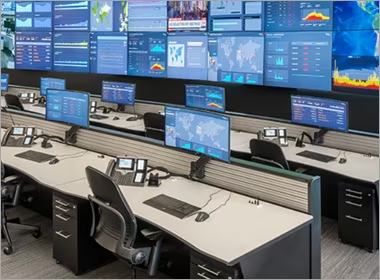
Network architecture for integrated operations centres: traffic management, public safety dispatch, emergency coordination, and municipal service monitoring with appropriate segmentation and redundancy.