
Electric Power Systems
Networking for substation communications, protection systems, and grid edge integration with deterministic timing requirements.
Water utility networks must maintain continuous operation for public health – where communication failures can mean undetected contamination, uncontrolled discharges, or supply interruptions affecting communities, requiring reliability that matches the essential nature of water services.
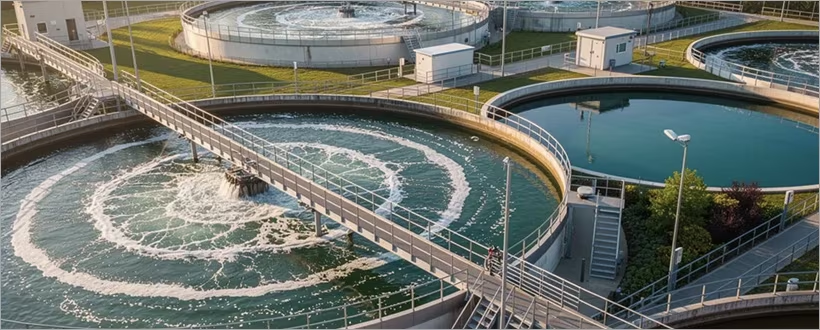
Water quality monitoring requires continuous data flow – gaps in communication mean periods where contamination could go undetected, while wastewater system failures risk environmental damage and regulatory violations.
Water treatment plants monitor numerous parameters: turbidity, pH, chlorine residual, pressure, flow. Wastewater systems track levels, flows, and treatment process parameters. Communication interruptions create blind spots where operators cannot see conditions or control processes. During storms or high-demand periods, these gaps become critical.
Effective water network design starts with identifying critical monitoring points and control functions. Network architecture then implements appropriate redundancy and reliability measures. Environmental challenges include remote pump stations, underground structures, and corrosive atmospheres in treatment plants.

Water treatment SCADA requires reliable communications for process control and water quality monitoring with redundancy for continuous public health protection.
Water treatment plants use supervisory control and data acquisition (SCADA) systems to monitor and control treatment processes, requiring networks that deliver continuous data flow with deterministic performance for critical control loops.
Treatment processes include chemical dosing, filtration, disinfection, and pumping. Each has control loops with specific timing requirements. Chlorine residual control, for example, needs consistent data flow to maintain safe levels. Network delays or interruptions affect treatment effectiveness.
Plant networks typically use industrial Ethernet with fibre optic backbones for immunity to electrical noise. Redundancy often uses ring topologies with rapid failover. Critical control loops may have dedicated networks or virtual local area networks (VLANs) with quality of service (QoS) guarantees. Equipment must survive wet, corrosive environments.
Pump stations and reservoirs in remote locations require reliable communications for level monitoring, pump control, and alarm reporting – often with limited power and challenging connectivity options.
Remote sites monitor levels, pressures, and equipment status. Control functions include pump start/stop and valve operation. Communication failures mean operators cannot see conditions or control equipment.
Communication technologies vary by location. Cellular (4G/LTE) works where coverage exists. Radio networks provide coverage in areas without cellular. Fibre offers highest reliability where available. Power considerations are critical – many sites use solar with battery backup. Redundancy often uses dual technologies: cellular primary with radio backup.
Water quality sensors, flow meters, and pressure transmitters generate data that must reach control systems reliably – network design affects measurement accuracy and response time for quality incidents.
Modern water systems deploy numerous sensors: pH, chlorine, turbidity, pressure, flow. Each provides essential data for operations and regulatory compliance. Network performance affects data timeliness and completeness.
Sensor networks often use industrial protocols like Modbus, PROFIBUS, or Ethernet/IP. Network design considers data rates and timing requirements. Some sensors need continuous communication; others report periodically. Time synchronisation ensures data correlation across the system.
Critical water infrastructure requires network resilience through redundancy, diverse paths, and robust design to maintain communications during failures or natural disasters.
Water infrastructure must maintain operation during natural disasters, equipment failures, and other disruptions – network resilience ensures communications continue when they're most needed for emergency response.
Storms, floods, earthquakes, and equipment failures can disrupt water systems. Network design must anticipate these events. Resilience approaches include diverse communication paths, backup power, and hardened equipment.
Fibre optic networks often follow diverse routes entering facilities. Wireless backup provides alternative paths. Equipment enclosures withstand environmental extremes. Testing validates failover under simulated disaster conditions.
Many water utilities operate legacy programmable logic controllers (PLCs) with serial communications – migration to modern networks requires careful planning to maintain operations during transition.
Older water systems use PLCs with serial interfaces (RS-232, RS-485). These lack modern security features and have limited diagnostics. Migration to Ethernet-based systems improves capabilities but must not disrupt operations.
Migration approaches include serial-to-Ethernet converters, protocol gateways, and phased replacement. Network segmentation isolates legacy equipment during transition. Testing ensures new systems replicate all functions before cutover.
Water operational technology (OT) cybersecurity must protect treatment and distribution systems from threats while maintaining continuous operation for public health – balancing security with service availability.
Water systems face cyber threats that could affect treatment or supply. Security measures must not disrupt operations. The approach follows utilities core guidance: segmentation, secure access, intrusion detection, and resilience.
Implementation starts with network segmentation separating OT from IT. Secure remote access enables maintenance without exposing systems. Intrusion detection monitors for water-specific anomalies. Resilience ensures security measures don't create single points of failure.
Throughput Technologies advises on water and wastewater networking that balances operational requirements with reliability needs, implemented in environments where communication failures directly affect public health and environmental protection.
Talk with a Solutions Specialist to design your water utility network infrastructure.
Cellular (4G/LTE) works where coverage exists, offering good bandwidth. Radio networks (licensed or unlicensed) provide coverage without cellular. Satellite works anywhere but has higher latency. Fibre offers highest reliability where available. Often a hybrid approach works best: cellular primary with radio backup. Consider power constraints – many sites use solar with battery storage. Choose technology based on data needs, reliability requirements, and site conditions.
Critical treatment processes need high redundancy – often dual networks with automatic failover. Less critical monitoring may tolerate single paths. The level depends on consequence of failure. Chlorine control needs higher redundancy than historical data logging. Design based on risk assessment: what processes affect water quality or supply if communications fail. Implement appropriate redundancy for each function, not one-size-fits-all.
Use efficient security measures. Certificate-based authentication uses less power than continuous challenges. Schedule security operations during daylight for solar sites. Implement physical security to reduce electronic monitoring needs. Balance security with power constraints – some remote monitoring may accept lower security than control systems. Use compensating controls like data validation at receiving systems.
Most water quality sensors generate low data rates – a few bytes per measurement. Update intervals vary: continuous parameters like pH may report every 1–5 seconds; compliance reporting may be hourly. The network must handle occasional bursts when multiple sensors report simultaneously. More important than raw bandwidth is reliability – missing data creates monitoring gaps. Design for consistent delivery rather than maximum throughput.
Use phased migration. Install new systems alongside old ones. Use protocol converters for interim operation. Test thoroughly before cutover. Schedule migration during low-demand periods if possible. Maintain fallback capability until new systems prove reliable. Document all interfaces and functions before migration. Train operators on new systems before decommissioning old ones. The key is maintaining operations throughout the transition.
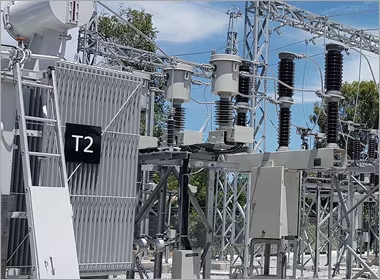
Networking for substation communications, protection systems, and grid edge integration with deterministic timing requirements.
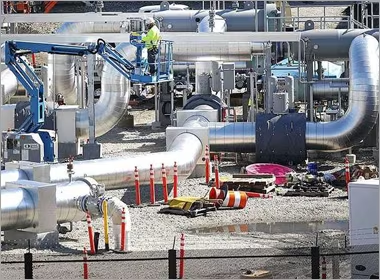
Networking for pipeline SCADA, leak detection, compressor station control, and long-distance communications.
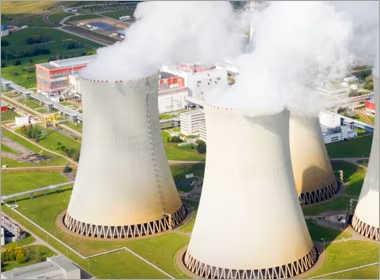
Networking for nuclear facilities where deterministic performance, diversity, and regulatory compliance govern architecture.